

Introduction
Choosing the correct transformer size is an important electrical design decision for any commercial building. A transformer that is too small can operate near or above its rated capacity, resulting in excessive heating, voltage problems, nuisance trips, reduced equipment life, and potential service interruptions. A transformer that is significantly oversized may cost more to purchase and install while operating inefficiently under light loads.
For commercial building owners in the USA and Canada, transformer sizing generally starts with determining the building’s connected electrical load and then applying appropriate demand, diversity, and power factor considerations. The final transformer selection also needs to account for the electrical service voltage, phase configuration, future expansion, motor starting requirements, harmonics, ambient conditions, and applicable electrical codes.
The basic transformer sizing calculation is straightforward:
Transformer Size (kVA) = Voltage × Current × √3 ÷ 1,000
for a three-phase system.
However, determining the correct current is where the real engineering work begins.
In this guide, we will walk through transformer sizing with practical commercial-building examples so that building owners, facility managers, contractors, and project teams can understand how the calculation works.
Important: Transformer sizing should be finalized by a qualified electrical engineer or electrical contractor based on the actual building design, utility requirements, equipment specifications, and applicable codes.
What Does a Transformer Do in a Commercial Building?
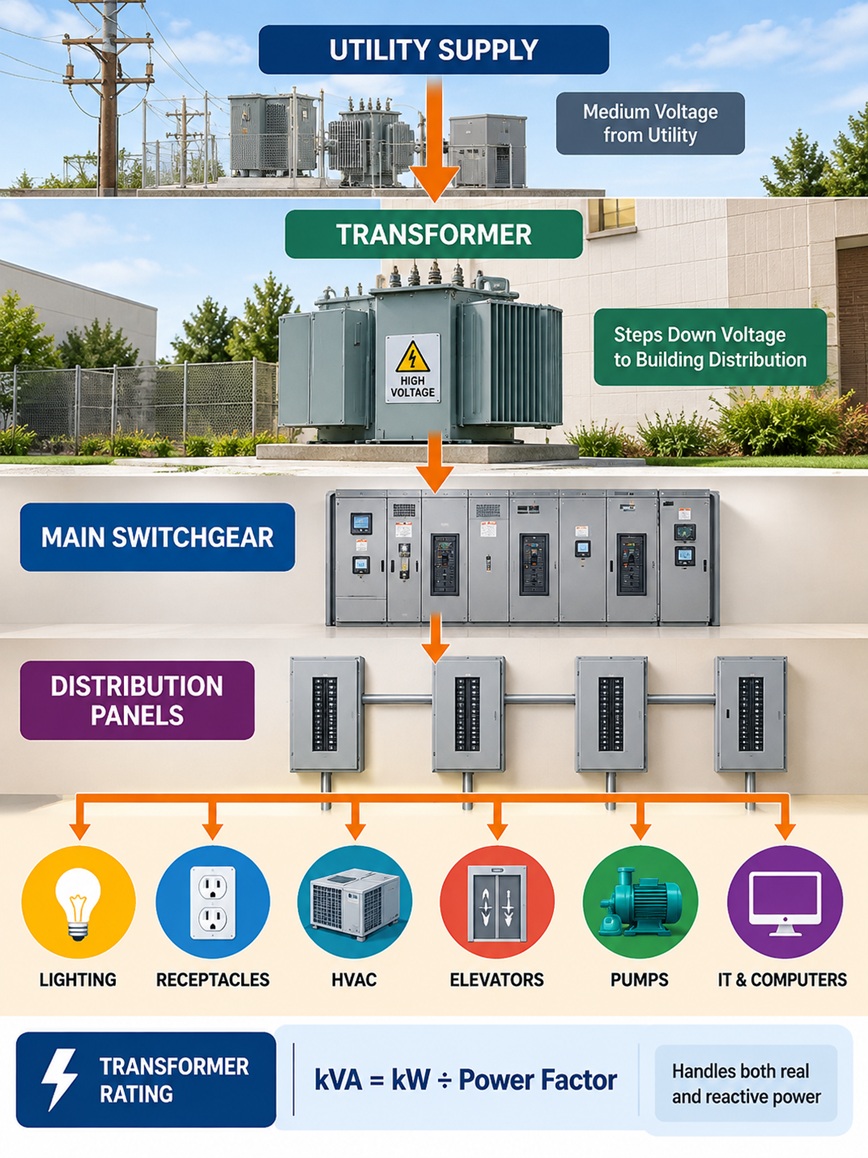
A transformer transfers electrical energy between circuits and can change the voltage to a level appropriate for the building’s electrical distribution system.
For example, a commercial property may receive electrical power from a utility at a medium-voltage level and use a transformer to provide a lower utilization voltage for lighting, receptacles, HVAC equipment, elevators, pumps, computers, and other building systems.
A commercial transformer may therefore be part of a system such as:
Utility Supply → Transformer → Main Switchgear → Distribution Panels → Building Loads
The transformer rating is normally expressed in kVA, or kilovolt-amperes, rather than simply watts.
This is because transformers must handle both real power and reactive power. The relationship between apparent power, real power, and power factor is:
kW = kVA × Power Factor
Therefore:
kVA = kW ÷ Power Factor
This relationship becomes particularly important when a building has motors, HVAC equipment, fluorescent lighting, UPS systems, or other inductive and electronic loads.
Step 1: List Every Major Electrical Load
The first step is to create a commercial building load schedule.
Do not simply add up the nameplate ratings of a few large pieces of equipment. A proper preliminary calculation should consider all significant electrical loads.
Typical commercial loads include:
- HVAC systems
- Air-conditioning compressors
- Air-handling units
- Pumps
- Elevators
- Escalators
- Lighting
- General receptacles
- Computers and office equipment
- Server rooms
- Kitchen equipment
- Electric water heaters
- Electric heating
- Fire pumps
- Security systems
- EV charging equipment
- Signage
- Emergency systems
For example, imagine a small office building with the following connected loads:
| Load | Connected Load |
|---|---|
| Lighting | 40 kW |
| General receptacles | 30 kW |
| HVAC | 150 kW |
| Elevators | 50 kW |
| Kitchen equipment | 25 kW |
| Computers and IT | 35 kW |
| Miscellaneous equipment | 20 kW |
| Total | 350 kW |
The connected load is therefore:
350 kW
But this does not automatically mean that you need a 350 kVA transformer.
The building will rarely operate every connected load at its maximum rating simultaneously.
That is where demand factors become important.
Step 2: Apply Demand Factors
A building’s connected load represents the maximum rated load of all equipment if everything were operating at its calculated maximum.
Actual operating demand is normally lower.
A demand factor can be expressed as:
Demand Factor = Maximum Demand ÷ Connected Load
Suppose the 350 kW connected load above has an estimated maximum demand of 245 kW.
The demand factor would be:
245 ÷ 350 = 0.70
or:
70%
For preliminary planning, the load schedule might look like this:
| Load | Connected Load | Estimated Demand | Demand Load |
|---|---|---|---|
| Lighting | 40 kW | 90% | 36 kW |
| Receptacles | 30 kW | 60% | 18 kW |
| HVAC | 150 kW | 80% | 120 kW |
| Elevators | 50 kW | 50% | 25 kW |
| Kitchen | 25 kW | 60% | 15 kW |
| IT | 35 kW | 80% | 28 kW |
| Miscellaneous | 20 kW | 50% | 10 kW |
| Total | 350 kW | 252 kW |
The estimated maximum demand is therefore approximately:
252 kW
These percentages are only an illustrative example. Actual demand calculations should follow the applicable electrical code, utility requirements, equipment characteristics, and engineering assumptions.
Step 3: Convert kW to kVA
Transformer ratings are generally specified in kVA.
If the estimated maximum demand is 252 kW and the expected operating power factor is 0.90, calculate:
kVA = kW ÷ Power Factor
kVA = 252 ÷ 0.90
kVA = 280 kVA
This means the calculated apparent power requirement is approximately:
280 kVA
However, you normally would not select a transformer rated at exactly 280 kVA if the next standard transformer rating is 300 kVA.
A 300 kVA transformer could therefore be considered for this example, subject to the complete engineering design.
Real Example 1: Small Commercial Office
Let’s consider a 20,000-square-foot office building.
The estimated connected loads are:
- Lighting: 35 kW
- HVAC: 120 kW
- Receptacles: 25 kW
- IT equipment: 30 kW
- Kitchen: 15 kW
- Other equipment: 15 kW
Total connected load:
240 kW
Assume the calculated maximum demand is approximately:
175 kW
Assume a power factor of:
0.90
The required transformer capacity becomes:
175 ÷ 0.90 = 194.4 kVA
A designer may therefore evaluate a transformer around the next appropriate standard rating, such as:
225 kVA
However, the final selection should consider future expansion and actual equipment characteristics.
If the building owner expects the office to add substantial EV charging, HVAC capacity, server equipment, or other loads, a larger transformer may be appropriate.
Real Example 2: Larger Retail Building
Consider a retail building with these estimated connected loads:
| Equipment | Load |
|---|---|
| Lighting | 100 kW |
| HVAC | 300 kW |
| Refrigeration | 100 kW |
| General receptacles | 50 kW |
| Office/IT | 40 kW |
| Other equipment | 60 kW |
| Total | 650 kW |
Suppose the calculated maximum demand after applying appropriate demand assumptions is:
500 kW
At a power factor of 0.92:
kVA = 500 ÷ 0.92
kVA ≈ 543 kVA
A transformer rating around 600 kVA might therefore be evaluated.
But there is another issue.
What happens if the building plans to add 100 kW of EV charging capacity?
The electrical design must consider whether the EV chargers are expected to operate simultaneously with the building’s other major loads.
Simply ignoring future loads could result in an undersized electrical service.
Real Example 3: Commercial Building With Motors
Motors can make transformer sizing more complicated.
Suppose a commercial facility has:
- HVAC motors
- Pumps
- Compressors
- Elevators
- Fans
The steady-state running load may be acceptable, but starting a large motor can produce a temporary current surge.
For example, imagine a motor with a full-load current of 100 A.
Depending on the motor type and starting method, starting current can be several times its normal running current.
If a large motor starts across the line, the temporary current demand can cause:
- Voltage dips
- Lighting flicker
- Control-system problems
- Motor starting difficulties
- Transformer voltage fluctuations
Therefore, transformer sizing cannot always be based only on the average running kW.
Engineers may need to evaluate motor starting characteristics and determine whether soft starters, variable-frequency drives, reduced-voltage starters, or other solutions are required.
Three-Phase Transformer Sizing Formula
For a three-phase transformer, apparent power can be calculated using:
kVA = √3 × V × A ÷ 1,000
Where:
- V = line-to-line voltage
- A = line current
- √3 ≈ 1.732
For example, suppose a commercial building has a 480 V three-phase electrical system and the calculated full-load current is 600 A.
Then:
kVA = 1.732 × 480 × 600 ÷ 1,000
kVA ≈ 498 kVA
A transformer rating around 500 kVA would therefore correspond closely to this calculated apparent load.
However, the final selection still requires consideration of loading, future expansion, temperature, installation conditions, harmonics, and code requirements.
How Much Transformer Capacity Should You Leave for Future Growth?
Future expansion is one of the most frequently overlooked parts of transformer sizing.
Suppose your calculated requirement is:
450 kVA
You might technically find a transformer that meets the present requirement.
But if the building is expected to add:
- EV chargers
- Additional HVAC
- More office space
- Data equipment
- Electric heating
- Production equipment
- Additional refrigeration
the future electrical demand could increase substantially.
Instead of designing only for today’s load, engineers may include a reasonable growth allowance based on the project’s expected future requirements.
For example:
450 kVA × 1.20 = 540 kVA
This does not automatically mean a 540 kVA transformer should be selected. Standard transformer ratings, available utility services, economics, fault-current calculations, and the actual expansion plan must also be evaluated.
The key point is that future load should be deliberately considered rather than added as an arbitrary percentage.
Don’t Forget Power Factor
Two buildings can consume the same amount of real power while requiring different transformer capacities.
Consider:
Building A
300 kW at 0.95 power factor
300 ÷ 0.95 = 316 kVA
Building B
300 kW at 0.80 power factor
300 ÷ 0.80 = 375 kVA
Both buildings consume 300 kW, but Building B requires considerably more apparent power.
Improving power factor can therefore reduce the apparent power requirement and electrical losses in some installations.
Commercial buildings with large motor loads or other inductive equipment should have their power factor evaluated as part of the electrical design.
Transformer Loading and Efficiency
Selecting a transformer is not simply about finding a kVA number.
Transformers have losses even when the building load is relatively low. These include core losses and load-dependent winding losses.
A transformer that is dramatically oversized may spend much of its operating life lightly loaded.
On the other hand, continuously operating close to the transformer’s maximum rating can increase thermal stress and reduce available capacity for unexpected demand.
The objective is to select an appropriately rated transformer that matches the building’s actual and reasonably anticipated electrical requirements.
Other Factors Commercial Building Owners Should Consider
Before purchasing or specifying a transformer, review the following:
Primary and Secondary Voltage
Confirm the utility service voltage and the voltage required by the building distribution system.
Single-Phase or Three-Phase
Most larger commercial buildings use three-phase electrical distribution, but the actual configuration depends on the project.
Frequency
The United States and Canada generally use 60 Hz electrical systems.
Indoor or Outdoor Installation
Transformer enclosure and environmental requirements depend on the installation location.
Ambient Temperature
Transformer ratings can be affected by installation conditions and temperature.
Harmonic Loads
Modern commercial buildings may contain significant nonlinear loads from computers, LED drivers, UPS systems, variable-frequency drives, and other electronic equipment.
Harmonic current can contribute to additional transformer heating and may require special consideration.
Short-Circuit Current
The transformer impedance and rating affect available fault current at downstream equipment.
The complete electrical system therefore needs to be evaluated for proper equipment ratings and protection.
Utility Requirements
The local electric utility may have specific requirements concerning transformer size, service voltage, metering, installation, and connection.
What Size Transformer Does a Commercial Building Need?
There is no universal transformer size based only on building square footage.
Two buildings with the same floor area can have completely different electrical requirements.
A 30,000-square-foot office building may have a substantially different electrical demand from a 30,000-square-foot restaurant, supermarket, warehouse, medical facility, or manufacturing space.
A more reliable approach is:
1. Determine connected loads
2. Calculate demand loads
3. Determine maximum demand
4. Evaluate power factor
5. Convert kW to kVA
6. Consider motor starting and nonlinear loads
7. Add justified future capacity
8. Select an appropriate standard transformer rating
9. Verify the electrical service and protection requirements
10. Confirm the design with a qualified electrical professional
Final Transformer Sizing Example
Let’s bring everything together.
Suppose a commercial building has:
Connected load: 800 kW
After applying appropriate demand calculations:
Maximum demand: 580 kW
Expected power factor:
0.92
Calculate apparent power:
580 ÷ 0.92 = 630.4 kVA
Now suppose the building has planned future expansion that could increase demand.
The engineering team may evaluate a transformer rating above the present calculated requirement, potentially considering a standard rating such as 750 kVA, depending on the actual design and available equipment.
The final decision should also consider motor starting, harmonics, load diversity, ambient conditions, utility requirements, fault current, transformer impedance, installation configuration, and applicable electrical codes.
Final Thoughts
Calculating transformer size for a commercial building is more than adding equipment nameplate ratings and choosing the next available transformer.
The basic process starts with the building’s connected load, but the final requirement depends on maximum demand, power factor, equipment characteristics, future expansion, operating conditions, and the electrical distribution system.
A useful preliminary formula is:
Transformer kVA = Maximum Demand kW ÷ Power Factor
For three-phase systems where voltage and current are known:
Transformer kVA = √3 × Voltage × Current ÷ 1,000
These formulas are useful for understanding the fundamentals and creating preliminary estimates. However, the final transformer specification should be developed and verified by a qualified electrical engineer or electrical contractor familiar with the applicable NEC, Canadian Electrical Code, local requirements, utility requirements, and project-specific conditions.
For commercial building owners, getting the transformer size right can help balance installation cost, operating efficiency, reliability, and future electrical capacity.
You can contact Electrical Engineers at Electrical.BazarOnWeb.com for professional electrical consulting and guidance on commercial electrical requirements.