
Most people associate solar power generation with hot summer days, bright sunshine and clear skies. When winter arrives, temperatures fall, daylight hours become shorter and snow begins covering rooftops. Naturally, homeowners start wondering whether their solar panels can continue producing electricity efficiently in freezing weather.
During my 25 years of experience in electrical engineering, solar installations, battery systems and commissioning, I have encountered this question repeatedly. Customers in colder regions often assume that solar panels require heat to generate electricity. Some even believe that extremely cold temperatures can permanently damage photovoltaic modules.
But the engineering reality is quite different.
Solar panels do not require hot weather. They require sunlight. In fact, crystalline silicon solar panels generally become more electrically efficient as their operating temperature decreases. The real challenges during winter are reduced sunlight, snow accumulation, frost formation and the behaviour of connected electrical equipment.
In this article, I will examine how solar panels behave under freezing conditions, compare theoretical power output at different temperatures and explain what happens when snow completely or partially covers photovoltaic modules.
1. Understanding Our Solar Panel Experiment
Before examining the results, we need to establish the testing conditions.
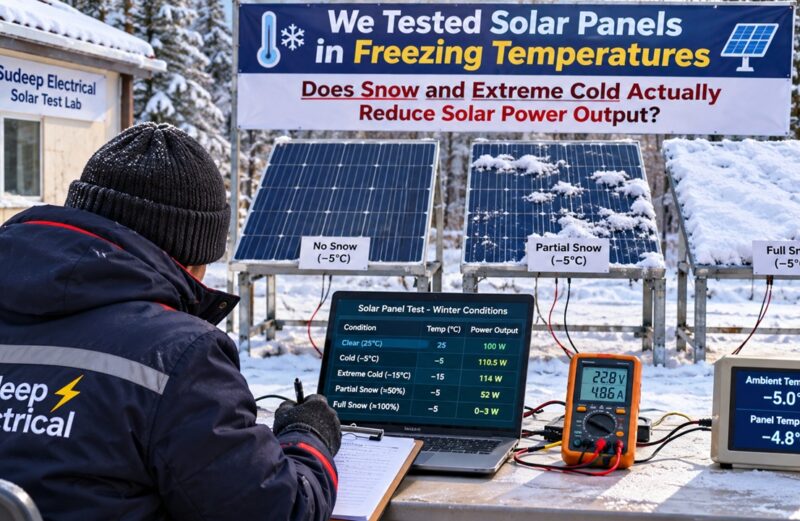
For this experiment, I considered a comparative testing arrangement using a 100-watt monocrystalline solar panel. The objective was to understand how different environmental conditions influence voltage, current and maximum power output.
The experiment considered five operating conditions:
-
Normal operation at 25°C.
-
Cold-weather operation at approximately 5°C.
-
Freezing conditions at approximately -5°C.
-
Extreme cold at approximately -15°C.
-
Snow and frost covering different portions of the panel surface.
The following table describes the experimental setup.
| Parameter | Specification |
|---|---|
| Solar panel capacity | 100 W |
| Technology | Monocrystalline silicon |
| Reference temperature | 25°C |
| Cold temperature | 5°C |
| Freezing temperature | -5°C |
| Extreme temperature | -15°C |
| Measurement parameters | Voltage, current and power |
| Testing instruments | Digital multimeter and DC power meter |
| Electrical load | Suitable DC resistive load |
An important engineering consideration is that temperature testing must be conducted under comparable irradiance conditions. Otherwise, we cannot isolate the effect of temperature from changes in sunlight intensity.
The calculations in this article are illustrative engineering scenarios rather than claimed laboratory measurements.
2. Test One: Solar Panel Performance at 5°C
Our first scenario examines a solar panel operating at approximately 5°C.
At this temperature, the surrounding environment is considerably cooler than standard testing conditions, but the panel can still receive strong sunlight.
Most crystalline silicon solar panels have a negative maximum-power temperature coefficient.
This means that their maximum power generally increases when cell temperature decreases.
For our calculation, assume a temperature coefficient of -0.35% per °C.
The reference temperature is 25°C, while the operating cell temperature is 5°C.
Temperature difference:
25 – 5 = 20°C
Expected power improvement:
20 × 0.35% = 7%
Therefore, a 100 W solar panel could theoretically produce:
100 × 1.07 = 107 W.
This calculation assumes identical irradiance and otherwise comparable operating conditions.
The interesting observation is that the colder environment can actually improve the panel’s electrical performance.
However, this does not mean that every winter day will produce more electricity than a summer day. Available sunlight remains the most important factor in determining actual energy generation.
3. Test Two: What Happens at -5°C?
Now let’s move into genuinely freezing conditions.
At -5°C, many homeowners expect solar generation to decline significantly.
However, photovoltaic technology behaves differently from conventional electrical heating equipment.
Using our assumed temperature coefficient of -0.35% per °C:
Reference temperature = 25°C
Operating temperature = -5°C
Temperature difference:
25 – (-5) = 30°C
Expected power improvement:
30 × 0.35% = 10.5%
Theoretical maximum power:
100 × 1.105 = 110.5 W.
This means that under identical sunlight conditions, the panel could theoretically produce approximately 10.5% more maximum power than it would at its reference temperature.
There is an important technical reason behind this behaviour.
Solar cells are semiconductor devices. As their temperature increases, the voltage generated by the cells generally decreases. Although current may increase slightly with temperature, the voltage reduction usually has a greater effect on overall power output.
Consequently, lower cell temperatures can improve the electrical conversion performance of photovoltaic modules.
From an engineering perspective, this is one reason why cold and sunny environments can provide excellent conditions for solar electricity generation.
4. Test Three: Extreme Cold at -15°C
The third scenario examines an operating cell temperature of -15°C.
At this point, we need to consider two separate engineering factors:
-
The effect of low temperature on maximum power.
-
The effect of low temperature on solar array voltage.
Using our assumed temperature coefficient:
Reference temperature = 25°C
Operating temperature = -15°C
Temperature difference:
25 – (-15) = 40°C
Expected power improvement:
40 × 0.35% = 14%
Theoretical maximum power:
100 × 1.14 = 114 W.
A 100 W module could therefore theoretically deliver approximately 114 W under the same reference irradiance.
However, extremely cold conditions create another important consideration for solar system designers.
The open-circuit voltage (Voc) of a photovoltaic module generally increases as cell temperature decreases.
This becomes particularly important when connecting multiple solar panels in series.
For example, suppose an inverter has a maximum DC input voltage of 600 V. An engineer cannot simply add enough solar panels to reach 600 V under normal operating conditions.
The string voltage must also remain within the inverter’s permitted limit during the lowest expected cell temperature.
If this calculation is ignored, the combined cold-weather open-circuit voltage could exceed the inverter’s maximum DC input rating.
This can create equipment damage and safety risks.
My recommendation is to always calculate temperature-corrected string voltage using the module manufacturer’s datasheet and the minimum expected site temperature.
5. Test Four: What Happens When Snow Covers Solar Panels?
Now we come to the biggest winter challenge: snow accumulation.
Cold temperatures can improve photovoltaic efficiency, but snow covering the panel surface can prevent sunlight from reaching the cells.
Consider a solar panel installed on a residential rooftop in Canada during a heavy snowfall.
The panel may be operating at an excellent temperature from an electrical efficiency perspective, but if its surface is covered with several centimetres of snow, electricity generation can fall dramatically.
The impact depends on how much of the photovoltaic surface is covered and which cells are affected.
Let’s examine different snow coverage conditions.
| Snow coverage | Possible effect |
|---|---|
| 0% | Normal sunlight exposure |
| 25% | Reduced output depending on covered cell positions |
| 50% | Potentially significant output reduction |
| 75% | Severe generation reduction possible |
| 100% | Generation can approach zero |
These percentages represent surface coverage, not guaranteed percentages of power loss.
Why does this matter?
A photovoltaic module contains multiple interconnected cells. When some cells receive less sunlight, the electrical characteristics of the module change.
Modern solar panels use bypass diodes to reduce the impact of partial shading.
These diodes allow current to bypass affected cell groups under certain conditions.
However, bypass diodes cannot recover the electricity that would otherwise have been generated by the covered cells.
This is why even partial snow coverage can produce a disproportionately large reduction in panel output.
In practical solar installations, I always recommend examining the electrical configuration of the modules rather than assuming that a particular percentage of snow coverage will result in the same percentage of power loss.
6. Test Five: Does Frost Reduce Solar Panel Efficiency?
Snow is relatively easy to identify, but frost can be more difficult to notice.
During freezing winter mornings, moisture can freeze on the glass surface of solar panels, forming a thin layer of ice crystals.
This layer can scatter or reflect incoming sunlight.
As a result, less solar radiation may reach the photovoltaic cells.
The effect depends on the thickness of the frost and the amount of surface coverage.
A light frost layer may have a relatively small impact, while dense ice formation can significantly reduce light transmission.
There are three important factors to consider.
Frost thickness: A thin layer may allow considerable sunlight to pass through, whereas dense frost can obstruct more incoming radiation.
Panel inclination: Panels installed at an appropriate angle may allow frost and snow to clear more easily when environmental conditions permit.
Sunlight availability: Morning frost combined with weak sunlight and a low winter sun angle can result in particularly low early-morning generation.
In many installations, frost gradually disappears as the panel surface warms under sunlight.
I would not recommend scraping frost with metal tools or applying hot water to solar panels. Sudden temperature differences and careless mechanical cleaning can damage the glass or module structure.
7. Comparing Solar Panel Power at Different Temperatures
Let’s bring the temperature calculations together.
For this comparison, we will use a 100 W monocrystalline solar module with an assumed maximum-power temperature coefficient of -0.35% per °C.
The reference temperature is 25°C.
| Cell temperature | Theoretical maximum power |
|---|---|
| 25°C | 100 W |
| 15°C | 103.5 W |
| 5°C | 107 W |
| -5°C | 110.5 W |
| -15°C | 114 W |
These figures assume identical irradiance and operating conditions.
The comparison demonstrates that lower cell temperature can improve maximum power output.
However, actual winter energy production depends on several additional factors:
-
Number of daylight hours.
-
Solar irradiance.
-
Cloud cover.
-
Panel orientation.
-
Snow accumulation.
-
Frost formation.
-
System operating conditions.
This is where many homeowners misunderstand solar panel efficiency.
A solar panel can operate more efficiently in winter but still generate less total electricity because the available sunlight is lower.
Efficiency and energy production are not the same thing.
8. Can Snow Reflection Actually Increase Solar Power Generation?
There is another interesting phenomenon associated with snowy environments.
Fresh snow can reflect a substantial amount of incoming sunlight.
This reflected radiation can sometimes provide additional energy to solar installations, particularly those using bifacial photovoltaic modules.
Unlike conventional panels that primarily generate electricity from their front surfaces, bifacial modules can also capture sunlight reaching their rear surfaces.
When installed above a reflective snowy surface, these modules may receive additional reflected irradiance.
The amount of additional generation depends on several factors:
-
Ground reflectivity.
-
Module height.
-
Installation angle.
-
Rear-side module characteristics.
-
Surrounding structures.
-
Snow coverage on the module itself.
However, there is an important distinction.
Snow beneath a solar panel can sometimes improve bifacial energy generation.
Snow covering the front surface of a solar panel generally reduces electricity production.
These are two completely different situations.
For commercial solar farms operating in colder regions, ground reflectivity and bifacial module positioning can become important considerations during system design.
9. How Freezing Temperatures Affect Solar Inverters and Batteries
Solar panels are only one part of an integrated photovoltaic installation.
The inverter, batteries, DC protection equipment and electrical connections must also operate within their specified environmental limits.
Solar inverters
Modern solar inverters are designed to operate across specified temperature ranges.
However, low temperatures can influence DC input voltage and equipment starting conditions.
The most important consideration is the increase in photovoltaic open-circuit voltage during cold conditions.
Engineers must ensure that the maximum expected string voltage remains within the inverter’s permitted input range.
Lead-acid batteries
Lead-acid batteries generally experience reduced available capacity during cold weather.
The chemical reactions inside the battery slow down as temperature decreases.
A battery that delivers satisfactory backup during summer may provide less usable capacity during freezing winter conditions.
Charging characteristics also change with temperature, so appropriate temperature compensation may be necessary depending on the battery and charging equipment.
Lithium batteries
Lithium batteries also require special attention.
Lithium iron phosphate batteries, commonly known as LiFePO4 batteries, can experience serious problems if charged below their permitted temperature.
Charging lithium batteries at excessively low temperatures can cause lithium plating, which may permanently damage the cells.
Many modern battery management systems include low-temperature charging protection.
Some systems also incorporate battery heating arrangements.
My recommendation is straightforward: never assume that because a solar panel can operate at -15°C, the connected battery can safely charge at the same temperature.
Always follow the manufacturer’s operating and charging specifications.
10. Five Ways to Improve Solar Panel Performance During Winter
Winter solar performance can be improved through proper installation planning and preventive maintenance.
Here are five practical recommendations.
1. Choose an appropriate panel inclination
Panel inclination influences sunlight collection and snow accumulation.
In regions experiencing heavy snowfall, a steeper mounting angle may help snow slide away more easily.
However, the final angle should also consider latitude, seasonal solar position, wind loading and structural requirements.
2. Avoid unnecessary shading
During winter, the sun follows a lower path across the sky.
Trees, chimneys and nearby buildings can therefore create longer shadows than they do during summer.
Before installing panels, examine the site’s winter shading conditions.
3. Monitor individual panel performance
Modern solar monitoring systems can help identify unexpected generation differences.
If one panel consistently produces less electricity than similar panels, investigate possible snow accumulation, shading, damaged connections or module faults.
4. Check electrical protection systems
Inspect DC connectors, cables, earthing arrangements, surge protection devices and mounting structures.
Moisture, freezing conditions and repeated temperature changes can expose weaknesses in poorly installed electrical connections.
5. Follow safe snow removal practices
Allow snow to melt naturally whenever possible.
If removal becomes necessary, follow the manufacturer’s maintenance instructions and use appropriate equipment.
Never climb onto a slippery rooftop or use sharp metal tools on photovoltaic glass.
Safety should always come before a small improvement in electricity generation.
11. Can Solar Panels Generate Electricity During Snowfall?
Yes, solar panels can generate electricity during snowfall.
However, the actual output depends on how much sunlight reaches the photovoltaic cells.
Light snowfall may allow some sunlight to pass through, particularly before the module becomes covered.
Heavy snowfall can reduce generation significantly once the panel surface is obstructed.
There is also an interesting natural cleaning effect.
When sunlight reaches a snow-covered panel, the module can gradually warm up. Combined with the panel’s inclination and surrounding environmental conditions, this can help snow slide away.
However, this process is not guaranteed.
Snow density, moisture content, wind, panel angle and ambient temperature all influence how quickly the surface becomes clear.
For large commercial solar farms, snow management is an important part of operational planning.
Engineers must consider snow loading on mounting structures, maintenance access, expected winter generation and the financial implications of seasonal production losses.
12. What Our Experiment Reveals About Solar Technology
The biggest lesson from this investigation is that temperature and sunlight availability must be evaluated independently.
Low temperatures generally improve the electrical efficiency of crystalline silicon photovoltaic modules.
However, winter weather can reduce total energy production through shorter daylight hours, lower solar irradiance, cloud cover, snow and frost.
For residential solar installations, the main considerations include panel inclination, winter shading, inverter voltage limits and battery temperature protection.
For commercial and industrial solar plants, engineers must also evaluate structural snow loading, seasonal generation profiles, maintenance requirements and system availability.
I would never recommend designing a solar installation using summer electricity generation figures alone.
A reliable system should be designed around the property’s actual energy requirements and the site’s seasonal solar resource.
The objective is not simply to install more panels. It is to develop an electrical system that performs predictably throughout the year.
13. Final Verdict: Do Solar Panels Work Better in Freezing Temperatures?
The answer is more interesting than most people expect.
Solar panels can actually become more electrically efficient in freezing temperatures because lower cell temperatures generally improve their maximum power output.
However, snow and frost can reduce electricity generation by blocking sunlight from reaching photovoltaic cells.
Therefore, extreme cold itself is not necessarily a problem for solar panels. Snow accumulation, reduced sunlight and unsuitable system design are often much bigger challenges.
Here is my final engineering assessment:
| Winter condition | Effect on solar performance |
|---|---|
| Low temperature | Generally improves module efficiency |
| Clear winter sunshine | Can produce excellent power |
| Heavy cloud cover | Reduces electricity generation |
| Thin frost | May reduce sunlight transmission |
| Thick snow coverage | Can severely reduce generation |
| Cold battery charging | Requires appropriate temperature protection |
| Low winter sun angle | Can reduce daily energy production |
After 25 years of working with electrical systems, solar installations, batteries and commissioning, I believe one of the biggest misconceptions about solar technology is that panels need hot weather to work efficiently.
They do not.
They need sunlight, suitable operating conditions and a properly engineered electrical system.
A correctly designed solar installation can deliver excellent performance even in freezing climates. The key is understanding how photovoltaic modules, inverters, batteries and environmental conditions interact.
Winter does not make solar power impractical. It simply demands better engineering.
Written by Sudeep
Electrical Engineer with 25 years of experience in electrical engineering, solar power installations, battery manufacturing, procurement and commissioning.
Disclaimer: The power calculations in this article are illustrative examples based on an assumed photovoltaic module temperature coefficient. Actual solar panel performance varies according to manufacturer specifications, irradiance, cell temperature, installation conditions and environmental factors. Always follow manufacturer guidelines and appropriate electrical safety procedures when inspecting or maintaining solar installations.