
Hello, I am Sudeep Srivastava, a Senior Electrical Engineer and Solar Energy Consultant with over 25 years of experience in electrical systems, solar power installations, battery technologies, and renewable energy solutions. One of the most common questions I receive from homeowners and businesses planning a solar installation is, “How long will my solar battery last?”
A solar battery is one of the most important investments in a solar power system. While solar panels generate electricity during daylight hours, batteries store excess energy for use during nighttime, power outages, and periods of low sunlight. The lifespan of a solar battery directly impacts the return on investment (ROI) of your solar energy system.
However, there is no single answer to battery lifespan because different battery technologies age differently. Factors such as battery chemistry, depth of discharge, charging cycles, temperature, maintenance, and installation quality all play significant roles in determining how long a battery will continue performing effectively.
In this comprehensive 2026 guide, I will explain the lifespan of various solar battery technologies, the factors affecting battery longevity, warning signs of battery degradation, and practical tips to maximize battery life. Understanding these aspects will help you choose the right battery technology and protect your investment for years to come.
1. Understanding Solar Battery Lifespan
Solar battery lifespan is generally measured in two ways: years of operation and charge-discharge cycles. A battery cycle refers to one complete discharge and recharge process. Every battery has a limited number of cycles before its storage capacity starts declining significantly.
For example, if a battery is rated for 6,000 cycles and completes one cycle per day, it can theoretically last over 16 years. However, actual lifespan depends on usage patterns and environmental conditions.
Manufacturers often provide warranties ranging from 5 to 15 years. These warranties usually guarantee that the battery will retain a certain percentage of its original storage capacity, commonly around 70–80%.
Battery lifespan is not the same as battery warranty. A battery may continue functioning beyond its warranty period, although with reduced efficiency and storage capability.
Another important concept is battery degradation. Over time, all batteries gradually lose their ability to hold a full charge. This process is natural and unavoidable. The goal is to slow down degradation through proper battery selection, installation, and maintenance.
Modern battery technologies have significantly improved compared to earlier generations. Advanced battery management systems (BMS), improved materials, and smart charging algorithms now allow many solar batteries to operate efficiently for more than a decade.
Understanding these basic concepts helps consumers make informed decisions and evaluate long-term costs rather than focusing only on the initial purchase price.
2. Lifespan of Lithium-Ion Solar Batteries
Lithium-ion batteries are currently the most popular solar storage technology worldwide. They are known for their high efficiency, compact size, minimal maintenance requirements, and long service life.
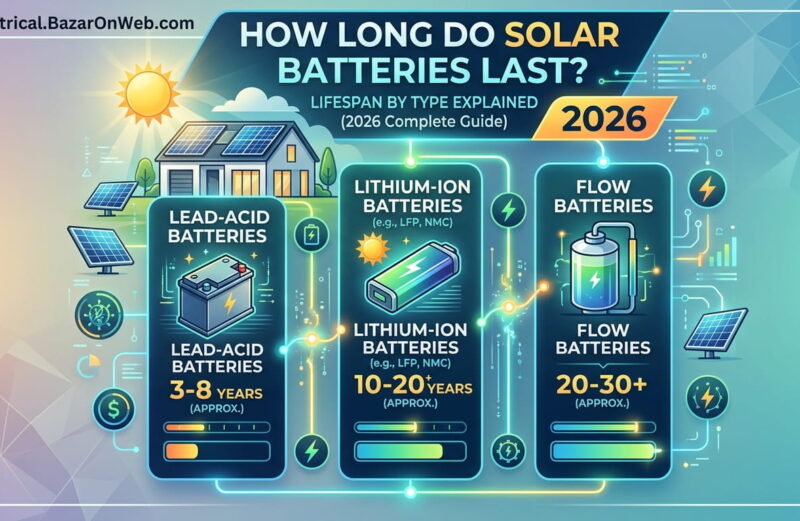
Most residential lithium-ion solar batteries last between 10 and 15 years under normal operating conditions. Premium models can achieve 6,000 to 10,000 charge cycles, making them ideal for daily cycling applications.
One reason for their popularity is their ability to handle deep discharges without significant damage. Many lithium batteries can safely utilize 80–100% of their rated capacity, providing greater usable energy storage.
Lithium-ion batteries also have excellent charging efficiency, often exceeding 95%. This means less energy is wasted during charging and discharging.
Temperature tolerance is another advantage. Although extreme heat can shorten lifespan, lithium batteries generally perform better than lead-acid alternatives under varying environmental conditions.
Battery management systems continuously monitor voltage, temperature, and charging behavior. These systems prevent overcharging and over-discharging, both of which can damage batteries.
For homeowners seeking long-term performance and lower maintenance costs, lithium-ion batteries are usually the preferred choice despite their higher upfront cost.
In 2026, lithium iron phosphate (LiFePO4) batteries are increasingly dominating the solar market due to their superior safety, thermal stability, and extended operational life.
3. Lifespan of Lithium Iron Phosphate (LiFePO4) Batteries
LiFePO4 batteries represent one of the most advanced forms of lithium battery technology available today. These batteries have become extremely popular in residential, commercial, and industrial solar installations.
A high-quality LiFePO4 battery typically lasts between 15 and 20 years. Many models are rated for 6,000 to 12,000 cycles, depending on operating conditions and discharge depth.
One major advantage is their exceptional thermal stability. Unlike some other lithium chemistries, LiFePO4 batteries are less prone to overheating and thermal runaway incidents.
Their chemistry allows frequent deep discharge cycles without significant performance degradation. This characteristic makes them ideal for off-grid solar systems where batteries are heavily utilized every day.
LiFePO4 batteries also maintain consistent voltage throughout the discharge cycle. This results in more stable power delivery to connected loads and inverters.
Maintenance requirements are virtually nonexistent. Unlike flooded lead-acid batteries, there is no need to check electrolyte levels or perform regular equalization charging.
The longer lifespan often offsets the higher initial investment. Although these batteries cost more upfront, the cost per cycle is generally lower over the battery’s lifetime.
For consumers planning a solar system in 2026, LiFePO4 batteries often provide the best combination of safety, durability, efficiency, and long-term value.
4. Lifespan of Lead-Acid Solar Batteries
Lead-acid batteries have been used in solar systems for decades and remain common in budget-conscious installations.
Traditional flooded lead-acid batteries typically last between 3 and 7 years. Their lifespan usually ranges from 500 to 1,500 cycles depending on usage patterns and maintenance quality.
These batteries require periodic maintenance, including checking water levels and cleaning terminals. Neglecting maintenance can significantly shorten battery life.
One limitation is their sensitivity to deep discharge. Repeatedly discharging beyond 50% capacity can dramatically accelerate degradation.
Lead-acid batteries are also heavier and larger than lithium alternatives. Their lower energy density means more installation space is required for equivalent storage capacity.
Despite these limitations, lead-acid batteries remain attractive due to their lower upfront cost. For applications with infrequent cycling or limited budgets, they can still be a practical option.
Proper ventilation is essential because flooded batteries release gases during charging. Installation errors can reduce both performance and safety.
While newer technologies continue to gain market share, lead-acid batteries remain relevant in specific applications where initial affordability is a priority.
5. Lifespan of AGM Batteries
Absorbent Glass Mat (AGM) batteries are a sealed lead-acid battery technology designed to improve reliability and reduce maintenance requirements.
AGM batteries generally last between 4 and 8 years. Depending on usage conditions, they may provide around 600 to 1,800 charge cycles.
Because they are sealed, AGM batteries do not require water refilling. This makes them more convenient than traditional flooded lead-acid batteries.
They also offer better vibration resistance and can be installed in a wider range of orientations. Their sealed construction reduces leakage risks and simplifies maintenance.
However, AGM batteries remain susceptible to damage from deep discharges. Frequent discharge below recommended limits can significantly reduce lifespan.
High temperatures can also accelerate aging. Proper installation in shaded and ventilated locations is essential for maximizing service life.
AGM batteries are often chosen for backup power applications where daily cycling is limited. In such environments, they can provide dependable performance for several years.
Although not as durable as lithium technologies, AGM batteries offer a balance between cost, convenience, and reliability.
6. Lifespan of Gel Batteries
Gel batteries are another type of sealed lead-acid battery commonly used in solar systems.
A typical gel battery lasts between 5 and 10 years and may provide 1,000 to 2,500 cycles under favorable operating conditions.
These batteries contain a gel-like electrolyte that minimizes leakage risks and improves resistance to vibration and temperature fluctuations.
Gel batteries perform particularly well in applications with moderate discharge rates. They are often used in telecommunications, marine systems, and remote solar installations.
One advantage is their improved tolerance to deeper discharges compared to conventional flooded batteries. However, they remain less durable than modern lithium technologies.
Charging voltage must be carefully controlled. Overcharging can create voids in the gel electrolyte, permanently reducing battery capacity.
Maintenance requirements are minimal because the battery is sealed. This makes them attractive for installations where regular servicing is difficult.
For users seeking a maintenance-free lead-acid solution, gel batteries offer respectable longevity and reliability.
7. Factors That Affect Solar Battery Lifespan
Several factors influence how long a solar battery will last.
Temperature is one of the most significant. Excessive heat accelerates chemical degradation, while extremely low temperatures can temporarily reduce performance.
Depth of discharge (DoD) also plays a critical role. Batteries generally last longer when they are not repeatedly discharged to very low levels.
Charging quality matters as well. Improper charging voltages can damage battery cells and reduce lifespan.
Battery sizing affects longevity. An undersized battery experiences greater stress because it must cycle more deeply and frequently.
Maintenance practices influence lifespan, particularly for lead-acid batteries. Clean terminals, proper electrolyte levels, and timely inspections help prevent premature failure.
Environmental conditions such as humidity, dust, and corrosion can also affect performance over time.
Selecting high-quality equipment and ensuring professional installation are among the most effective ways to maximize battery lifespan.
8. Signs Your Solar Battery Is Aging
All batteries eventually show signs of aging.
Reduced storage capacity is often the first indication. Users may notice shorter backup times or increased dependence on grid electricity.
Longer charging times can indicate declining battery efficiency. Aging batteries often require more time to reach full charge.
Unexpected voltage fluctuations may suggest internal cell deterioration.
Physical symptoms such as swelling, corrosion, leakage, or unusual odors should never be ignored. These may indicate serious battery problems requiring immediate attention.
Frequent inverter warnings or battery management system alerts can also signal declining battery health.
Monitoring battery performance through smart energy management systems allows early detection of problems before major failures occur.
Regular inspections help identify issues and extend battery life through timely corrective action.
9. How to Extend the Life of Solar Batteries
Proper care can significantly extend battery lifespan.
Install batteries in a cool, dry, and ventilated location. Avoid exposing them to direct sunlight or excessive heat.
Follow manufacturer recommendations for charging and discharge limits.
Avoid frequent deep discharges whenever possible. Maintaining moderate discharge levels reduces stress on battery cells.
Use high-quality solar charge controllers and inverters with proper battery protection features.
Keep battery terminals clean and free from corrosion.
Perform routine inspections to identify loose connections, damaged cables, or signs of deterioration.
For lead-acid batteries, follow maintenance schedules carefully and ensure electrolyte levels remain within recommended ranges.
These simple practices can add years to battery service life and improve overall system reliability.
10. Which Solar Battery Type Lasts the Longest in 2026?
When comparing all major battery technologies available in 2026, LiFePO4 batteries generally offer the longest lifespan.
Many premium LiFePO4 systems exceed 15 years of service and can deliver more than 10,000 cycles under ideal conditions.
Lithium-ion batteries follow closely, offering excellent performance and durability for residential applications.
Gel batteries and AGM batteries provide moderate lifespans and may be suitable for specific budget or operational requirements.
Traditional flooded lead-acid batteries have the shortest lifespan but remain the most affordable option for many users.
The best choice depends on your budget, energy requirements, climate, maintenance preferences, and long-term goals.
For most homeowners and businesses seeking maximum return on investment, lithium-based technologies continue to be the preferred solution due to their superior longevity, efficiency, and reliability.
Conclusion
Solar batteries are a crucial component of modern solar energy systems, and understanding their lifespan is essential for making informed investment decisions. While traditional lead-acid batteries may last between 3 and 7 years, modern lithium-ion and LiFePO4 batteries can provide reliable service for 10 to 20 years or more.
As a solar consultant with over 25 years of experience, I recommend evaluating battery technology based not only on upfront cost but also on long-term performance, maintenance requirements, efficiency, and cycle life. A higher-quality battery often delivers better value over its operational lifetime.
With proper installation, smart energy management, and regular maintenance, solar batteries can provide dependable energy storage for many years, helping homeowners and businesses maximize the benefits of renewable energy while reducing electricity costs and improving energy independence.
— Sudeep Srivastava
Senior Electrical Engineer & Solar Energy Consultant