

One of the biggest advantages of owning an electric vehicle is the ability to charge it at home. Instead of visiting a gas station every week, you can plug in your car overnight and start the next morning with a charged battery.
But how much electricity does an electric car actually consume? Is charging at home cheaper than buying gasoline? Does a Level 2 charger increase your electricity bill significantly? And how much can you save by charging during off-peak hours?
As an electrical engineer, I look at these questions through three practical measurements: energy consumption in kilowatt-hours (kWh), the electricity rate per kWh, and charging efficiency.
For homeowners in the United States and Canada, these factors can make a substantial difference because electricity prices vary considerably between states, provinces, utilities, and residential rate plans.
Let’s calculate the costs using realistic examples, compare charging methods, and explore how you can estimate your own monthly EV charging bill.
1. How Is the Cost of Home EV Charging Calculated?
The basic formula is straightforward:
Charging Cost = Electricity Consumed × Electricity Rate
Suppose your electric vehicle draws 40 kWh from your home’s electrical supply, and your electricity rate is $0.15 per kWh.
Your charging cost is:
40 kWh × $0.15 = $6.00
However, there is an important detail: the energy drawn from your electrical supply is not always identical to the energy stored in the battery. Some energy is lost during charging because of heat, power conversion, battery conditioning, and other factors.
For a more accurate estimate, use:
Charging Cost = Battery Energy Required ÷ Charging Efficiency × Electricity Rate
If the battery needs 40 kWh and charging efficiency is 90%:
-
Energy drawn from the grid: 40 ÷ 0.90 = 44.4 kWh
-
Electricity rate: $0.15/kWh
-
Total cost: 44.4 × $0.15 = $6.67
For this example, the driver pays approximately $6.67 to put 40 kWh into the battery.
2. What Are the Average Electricity Rates in the USA and Canada?
Electricity rates are among the biggest factors affecting home charging costs.
According to the U.S. Energy Information Administration, the average U.S. residential electricity price was 17.30 cents per kWh in 2025. Actual rates vary significantly by state and utility.
In Canada, residential electricity costs vary by province and territory, as well as by consumption tier, delivery charges, and taxes. Quebec and Manitoba generally have relatively low residential electricity prices, while some northern jurisdictions have much higher costs.
For practical calculations, we can use these illustrative rates:
| Location or scenario | Example rate |
|---|---|
| Lower-cost U.S. electricity | US$0.12/kWh |
| U.S. planning estimate | US$0.17/kWh |
| Higher-cost U.S. electricity | US$0.30/kWh |
| Lower-cost Canadian electricity | C$0.10/kWh |
| Canadian planning estimate | C$0.15/kWh |
| Higher-cost Canadian electricity | C$0.25/kWh |
These are example rates for calculations, not official averages for each category. Check your utility bill for the applicable energy rate and any relevant time-of-use pricing.
One detail is worth remembering: your bill may include fixed monthly charges, delivery fees, taxes, and other components. Not all of these increase directly with EV charging. For estimating the extra cost of charging, use the marginal cost of electricity, including variable charges that apply to the additional consumption.
3. Use This Home EV Charging Cost Calculator
You can estimate the cost of charging your electric vehicle using the calculator below. Enter your battery energy requirement, charging efficiency, and local electricity rate.
Home EV charging cost calculator
Calculate your electric car charging costs, monthly electricity bill, annual expenses and driving cost in the USA or Canada.
Your EV charging cost estimate
US$7.56
US$90.67
US$1,088.00
US$5.67
Battery energy per session: 40.0 kWh
Electricity drawn from grid per session: 44.44 kWh
Estimated monthly grid consumption: 533.33 kWh
Electricity rate: US$0.170/kWh
Estimates exclude fixed utility charges, charger installation, taxes not included in your rate, and public charging. Charging losses are estimated using your selected efficiency. Actual costs vary with temperature, vehicle operation, utility tariffs and charging behaviour.
4. Real Example: Charging a 60 kWh Battery
Let's consider an EV with a 60 kWh battery that needs 40 kWh added during a typical charging session.
Assume charging efficiency is 90%. The electricity drawn from the home supply is:
40 ÷ 0.90 = 44.4 kWh
Now compare three electricity rates.
| Electricity rate | Cost for 44.4 kWh |
|---|---|
| US$0.12/kWh | US$5.33 |
| US$0.17/kWh | US$7.55 |
| US$0.30/kWh | US$13.33 |
The same vehicle and charging session can cost more than twice as much depending on the electricity price.
This is why an EV owner's location and electricity tariff can matter just as much as the vehicle's battery capacity.
5. How Much Does It Cost to Charge an EV Every Month?
Your monthly charging cost depends on how far you drive and how much electricity your vehicle consumes.
Suppose you drive 1,000 miles per month in the United States. Your EV consumes 30 kWh per 100 miles, measured at the battery, and charging efficiency is 90%.
Monthly battery energy:
1,000 × 30 ÷ 100 = 300 kWh
Energy drawn from the grid:
300 ÷ 0.90 = 333.3 kWh
At US$0.17 per kWh:
333.3 × $0.17 = US$56.67 per month
For a Canadian driver traveling 1,500 kilometres monthly, assume consumption of 18 kWh per 100 km, 90% charging efficiency, and an electricity rate of C$0.15/kWh.
-
Battery energy: 270 kWh
-
Grid electricity: 300 kWh
-
Monthly cost: C$45
These examples exclude fixed utility charges and assume the stated electricity rate applies to all additional charging consumption.
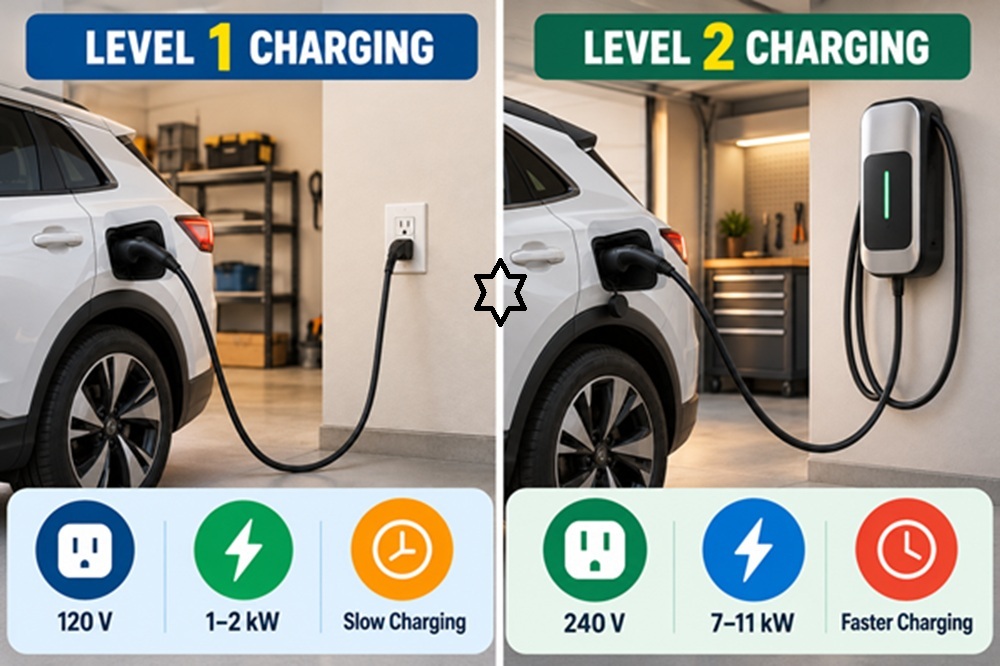
6. How Long Does It Take to Charge an Electric Car at Home?
Charging time depends on the charger output, vehicle charging capability, battery size, and how much energy needs to be added.
Level 1 charging
Typical US household outlet
Usually adds only a few miles of range per hour. It can work for low-mileage drivers, but replenishing a large battery may take more than a day.
How Much Does It Cost to Charge an Electric Car at Home in the USA and Canada? Electricity Rates, Charging Time and Cost Calculator
SEO Title: Cost to Charge an Electric Car at Home in the USA and Canada
Meta Description: Calculate home EV charging costs in the USA and Canada. Compare electricity rates, charging time, energy consumption, and monthly charging expenses.
50-Word Voiceover
How much does it really cost to charge an electric car at home? The answer depends on your electricity rate, battery size, driving distance, and charging efficiency. From a standard household outlet to a Level 2 charger, understanding energy consumption can help you estimate costs, reduce expenses, and charge smarter.
Disclaimer: Electricity prices, vehicle efficiency, and charging costs vary by location, utility tariff, vehicle model, and season. All examples in this article are illustrative estimates, not guaranteed local rates. Consult a qualified electrician before installing EV charging equipment.
Introduction
One of the biggest advantages of owning an electric vehicle is the ability to charge it at home. Instead of visiting a gas station every week, you can plug in your car overnight and start the next morning with a charged battery.
But how much electricity does an electric car actually consume? Is charging at home cheaper than buying gasoline? Does a Level 2 charger increase your electricity bill significantly? And how much can you save by charging during off-peak hours?
As an electrical engineer, I look at these questions through three practical measurements: energy consumption in kilowatt-hours (kWh), the electricity rate per kWh, and charging efficiency.
For homeowners in the United States and Canada, these factors can make a substantial difference because electricity prices vary considerably between states, provinces, utilities, and residential rate plans.
Let's calculate the costs using realistic examples, compare charging methods, and explore how you can estimate your own monthly EV charging bill.
1. How Is the Cost of Home EV Charging Calculated?
The basic formula is straightforward:
Charging Cost = Electricity Consumed × Electricity Rate
Suppose your electric vehicle draws 40 kWh from your home's electrical supply, and your electricity rate is $0.15 per kWh.
Your charging cost is:
40 kWh × $0.15 = $6.00
However, there is an important detail: the energy drawn from your electrical supply is not always identical to the energy stored in the battery. Some energy is lost during charging because of heat, power conversion, battery conditioning, and other factors.
For a more accurate estimate, use:
Charging Cost = Battery Energy Required ÷ Charging Efficiency × Electricity Rate
If the battery needs 40 kWh and charging efficiency is 90%:
-
Energy drawn from the grid: 40 ÷ 0.90 = 44.4 kWh
-
Electricity rate: $0.15/kWh
-
Total cost: 44.4 × $0.15 = $6.67
For this example, the driver pays approximately $6.67 to put 40 kWh into the battery.
2. What Are the Average Electricity Rates in the USA and Canada?
Electricity rates are among the biggest factors affecting home charging costs.
According to the U.S. Energy Information Administration, the average U.S. residential electricity price was 17.30 cents per kWh in 2025. Actual rates vary significantly by state and utility.
In Canada, residential electricity costs vary by province and territory, as well as by consumption tier, delivery charges, and taxes. Quebec and Manitoba generally have relatively low residential electricity prices, while some northern jurisdictions have much higher costs.
For practical calculations, we can use these illustrative rates:
| Location or scenario | Example rate |
|---|---|
| Lower-cost U.S. electricity | US$0.12/kWh |
| U.S. planning estimate | US$0.17/kWh |
| Higher-cost U.S. electricity | US$0.30/kWh |
| Lower-cost Canadian electricity | C$0.10/kWh |
| Canadian planning estimate | C$0.15/kWh |
| Higher-cost Canadian electricity | C$0.25/kWh |
These are example rates for calculations, not official averages for each category. Check your utility bill for the applicable energy rate and any relevant time-of-use pricing.
One detail is worth remembering: your bill may include fixed monthly charges, delivery fees, taxes, and other components. Not all of these increase directly with EV charging. For estimating the extra cost of charging, use the marginal cost of electricity, including variable charges that apply to the additional consumption.
3. Use This Home EV Charging Cost Calculator
You can estimate the cost of charging your electric vehicle using the calculator below. Enter your battery energy requirement, charging efficiency, and local electricity rate.
Home EV charging cost calculator
4. Real Example: Charging a 60 kWh Battery
Let's consider an EV with a 60 kWh battery that needs 40 kWh added during a typical charging session.
Assume charging efficiency is 90%. The electricity drawn from the home supply is:
40 ÷ 0.90 = 44.4 kWh
Now compare three electricity rates.
| Electricity rate | Cost for 44.4 kWh |
|---|---|
| US$0.12/kWh | US$5.33 |
| US$0.17/kWh | US$7.55 |
| US$0.30/kWh | US$13.33 |
The same vehicle and charging session can cost more than twice as much depending on the electricity price.
This is why an EV owner's location and electricity tariff can matter just as much as the vehicle's battery capacity.
5. How Much Does It Cost to Charge an EV Every Month?
Your monthly charging cost depends on how far you drive and how much electricity your vehicle consumes.
Suppose you drive 1,000 miles per month in the United States. Your EV consumes 30 kWh per 100 miles, measured at the battery, and charging efficiency is 90%.
Monthly battery energy:
1,000 × 30 ÷ 100 = 300 kWh
Energy drawn from the grid:
300 ÷ 0.90 = 333.3 kWh
At US$0.17 per kWh:
333.3 × $0.17 = US$56.67 per month
For a Canadian driver traveling 1,500 kilometres monthly, assume consumption of 18 kWh per 100 km, 90% charging efficiency, and an electricity rate of C$0.15/kWh.
-
Battery energy: 270 kWh
-
Grid electricity: 300 kWh
-
Monthly cost: C$45
These examples exclude fixed utility charges and assume the stated electricity rate applies to all additional charging consumption.
6. How Long Does It Take to Charge an Electric Car at Home?
Charging time depends on the charger output, vehicle charging capability, battery size, and how much energy needs to be added.
Level 1 charging
Typical US household outlet
Usually adds only a few miles of range per hour. It can work for low-mileage drivers, but replenishing a large battery may take more than a day.
Level 2 charging
Dedicated 240 V charging equipment
Common home installations can deliver approximately 7 to 11 kW, depending on circuit capacity and the vehicle. This is often convenient for overnight charging.
For example, adding 40 kWh using a charger delivering 7.2 kW would take approximately:
40 ÷ 7.2 = 5.6 hours
Actual charging time may be longer because of charging losses, vehicle limits, temperature, and battery management.
A faster charger does not automatically make each kWh more expensive. If the electricity rate stays the same, the energy cost is broadly similar for the same amount of energy delivered to the battery.
7. Is Home Charging Cheaper Than Gasoline?
Let's compare a gasoline vehicle with an EV traveling 1,000 miles per month.
Assume the gasoline vehicle achieves 30 miles per gallon and gasoline costs US$3.50 per gallon.
Gasoline consumption:
1,000 ÷ 30 = 33.3 gallons
Monthly gasoline cost:
33.3 × $3.50 = US$116.67
Using our earlier EV example, home charging costs approximately US$56.67 monthly.
The estimated energy-cost difference is:
US$116.67 − US$56.67 = US$60 per month
That equals approximately US$720 annually.
This is an illustrative comparison, not a guarantee of savings. Your actual result depends on fuel prices, vehicle efficiency, electricity rates, public fast charging, and driving conditions. It also excludes purchase price, insurance, maintenance, and depreciation.
8. How Can You Reduce Home EV Charging Costs?
Here are several practical steps I recommend homeowners consider.
Use off-peak electricity rates. If your utility offers time-of-use pricing, schedule charging during cheaper hours. Check that the plan's other charges do not outweigh the savings.
Avoid charging losses where practical. Use compatible, properly installed charging equipment and follow the vehicle manufacturer's guidance. Charging efficiency varies with temperature, charging power, and battery conditioning.
Choose the right charging speed. A properly installed Level 2 charger offers convenience for many drivers. You do not necessarily need the highest-power home charger available.
Check your actual electricity bill. Use the marginal rate that applies to additional charging rather than relying on a national average.
Consider solar power. If your home has solar panels, charging when surplus solar electricity is available may reduce grid electricity purchases. The financial benefit depends on your export credits, solar production, and charging schedule.
Monitor monthly consumption. Your vehicle's energy-use display and home charging app can help you compare expected and actual electricity consumption.
Final Thoughts
Charging an electric car at home can cost just a few dollars per session, but the exact amount depends on battery energy, driving distance, charging efficiency, and local electricity prices.
The calculation is simple:
Home charging cost = Battery energy required ÷ Charging efficiency × Electricity rate
For example, adding 40 kWh to a battery at 90% charging efficiency requires approximately 44.4 kWh from the electrical supply. At US$0.17/kWh, that session costs about US$7.55.
For homeowners in the USA and Canada, the smartest approach is to calculate costs using your actual electricity tariff and vehicle consumption rather than relying on a generic estimate.
From an electrical engineering perspective, I also recommend checking your home's available electrical capacity before installing a Level 2 charger. A qualified electrician can assess the existing panel, circuit requirements, load management options, grounding, and applicable local code requirements.
Understanding both the energy cost and the electrical installation will help you charge conveniently, estimate your monthly budget, and make informed decisions about home EV charging.
For electrical consulting and guidance on residential electrical installations, you can contact the electrical engineering team at Electrical.BazarOnWeb.com.
Dedicated 240 V charging equipment
Common home installations can deliver approximately 7 to 11 kW, depending on circuit capacity and the vehicle. This is often convenient for overnight charging.
For example, adding 40 kWh using a charger delivering 7.2 kW would take approximately:
40 ÷ 7.2 = 5.6 hours
Actual charging time may be longer because of charging losses, vehicle limits, temperature, and battery management.
A faster charger does not automatically make each kWh more expensive. If the electricity rate stays the same, the energy cost is broadly similar for the same amount of energy delivered to the battery.
7. Is Home Charging Cheaper Than Gasoline?
Let's compare a gasoline vehicle with an EV traveling 1,000 miles per month.
Assume the gasoline vehicle achieves 30 miles per gallon and gasoline costs US$3.50 per gallon.
Gasoline consumption:
1,000 ÷ 30 = 33.3 gallons
Monthly gasoline cost:
33.3 × $3.50 = US$116.67
Using our earlier EV example, home charging costs approximately US$56.67 monthly.
The estimated energy-cost difference is:
US$116.67 − US$56.67 = US$60 per month
That equals approximately US$720 annually.
This is an illustrative comparison, not a guarantee of savings. Your actual result depends on fuel prices, vehicle efficiency, electricity rates, public fast charging, and driving conditions. It also excludes purchase price, insurance, maintenance, and depreciation.
8. How Can You Reduce Home EV Charging Costs?
Here are several practical steps I recommend homeowners consider.
Use off-peak electricity rates. If your utility offers time-of-use pricing, schedule charging during cheaper hours. Check that the plan's other charges do not outweigh the savings.
Avoid charging losses where practical. Use compatible, properly installed charging equipment and follow the vehicle manufacturer's guidance. Charging efficiency varies with temperature, charging power, and battery conditioning.
Choose the right charging speed. A properly installed Level 2 charger offers convenience for many drivers. You do not necessarily need the highest-power home charger available.
Check your actual electricity bill. Use the marginal rate that applies to additional charging rather than relying on a national average.
Consider solar power. If your home has solar panels, charging when surplus solar electricity is available may reduce grid electricity purchases. The financial benefit depends on your export credits, solar production, and charging schedule.
Monitor monthly consumption. Your vehicle's energy-use display and home charging app can help you compare expected and actual electricity consumption.
Final Thoughts
Charging an electric car at home can cost just a few dollars per session, but the exact amount depends on battery energy, driving distance, charging efficiency, and local electricity prices.
The calculation is simple:
Home charging cost = Battery energy required ÷ Charging efficiency × Electricity rate
For example, adding 40 kWh to a battery at 90% charging efficiency requires approximately 44.4 kWh from the electrical supply. At US$0.17/kWh, that session costs about US$7.55.
For homeowners in the USA and Canada, the smartest approach is to calculate costs using your actual electricity tariff and vehicle consumption rather than relying on a generic estimate.
From an electrical engineering perspective, I also recommend checking your home's available electrical capacity before installing a Level 2 charger. A qualified electrician can assess the existing panel, circuit requirements, load management options, grounding, and applicable local code requirements.
Understanding both the energy cost and the electrical installation will help you charge conveniently, estimate your monthly budget, and make informed decisions about home EV charging.
For electrical consulting and guidance on residential electrical installations, you can contact the electrical engineering team at Electrical.BazarOnWeb.com.
Disclaimer: Electricity prices, vehicle efficiency, and charging costs vary by location, utility tariff, vehicle model, and season. All examples in this article are illustrative estimates, not guaranteed local rates. Consult a qualified electrician before installing EV charging equipment.