

If you still have a few old incandescent bulbs running in your home, you may be paying more for lighting than you realize. Incandescent bulbs are inexpensive to buy, familiar to use, and produce a warm light that many people like. The problem is that much of the electricity they consume becomes heat rather than visible light.
LED bulbs work differently. They can produce similar amounts of light while using a fraction of the electricity. But how much difference does that actually make on a household electricity bill?
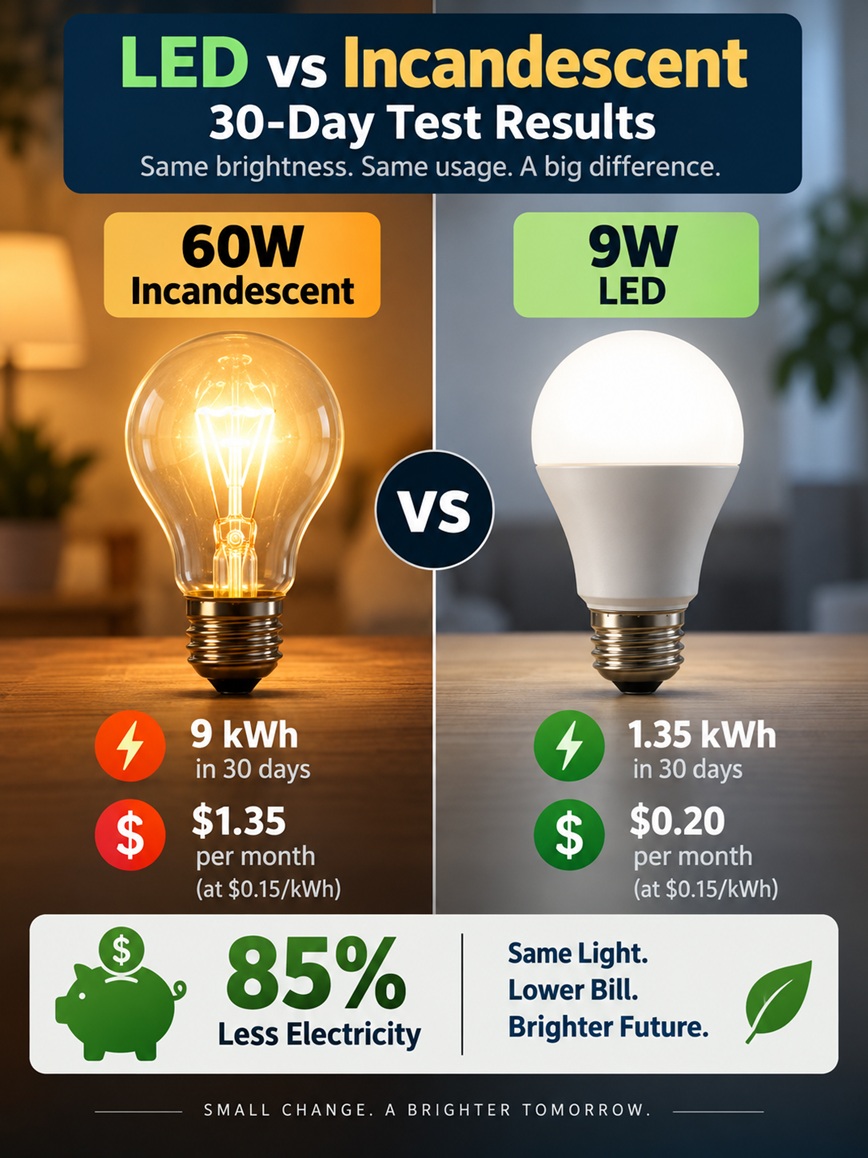
We decided to compare an old-style incandescent bulb with a modern LED bulb over a 30-day period. The goal was simple: use both bulbs for the same amount of time, calculate their electricity consumption, and estimate what that energy would cost a typical household in the United States or Canada.
The results show why lighting technology has changed so dramatically over the last decade.
Our 30-Day LED vs Incandescent Test
For a fair comparison, we selected bulbs designed to provide approximately similar brightness.
Our test setup was:
- Incandescent bulb: 60 watts
- LED bulb: 9 watts
- Usage: 5 hours per day
- Test period: 30 days
- Total operating time: 150 hours
- Comparison: Electricity consumed and estimated energy cost
The important point is that we are comparing energy consumption, not simply the purchase price of the bulbs.
A 60-watt incandescent bulb consumes 60 watts whenever it is operating. A comparable LED bulb may consume around 8 to 10 watts while producing a similar amount of useful light.
For our calculation, we used a 9-watt LED.
That means the incandescent bulb uses:
60 ÷ 9 = 6.67 times more power
during operation.
That difference becomes significant when the bulb is used every day.
How Much Electricity Does a 60-Watt Incandescent Bulb Use?
Let’s start with the old incandescent bulb.
A 60-watt bulb uses 60 watts, or 0.06 kilowatts, while operating.
If we use it for five hours every day:
0.06 kW × 5 hours = 0.30 kWh per day
Over 30 days:
0.30 × 30 = 9 kWh
So one 60-watt incandescent bulb operating for five hours every day consumes approximately 9 kWh per month.
That may not sound like much.
After all, 9 kWh is only a small fraction of the electricity consumption of an entire home.
But lighting is rarely limited to one bulb.
A typical house can have dozens of light fixtures. If several incandescent bulbs are used for several hours every day, the energy consumption can add up.
How Much Electricity Does a 9-Watt LED Use?
Now let’s run exactly the same calculation for the LED bulb.
A 9-watt LED uses:
9 watts = 0.009 kW
At five hours per day:
0.009 kW × 5 hours = 0.045 kWh per day
Over 30 days:
0.045 × 30 = 1.35 kWh
So the LED consumes approximately 1.35 kWh during the same 30-day test.
Now we can compare the two.
| Bulb | Power | Daily Use | 30-Day Consumption |
|---|---|---|---|
| Incandescent | 60 W | 5 hours | 9.0 kWh |
| LED | 9 W | 5 hours | 1.35 kWh |
| Difference | 51 W | Same | 7.65 kWh |
The LED saves approximately 7.65 kWh per month for one bulb under these conditions.
That is about an 85% reduction in electricity consumption for the lighting task.
What Does That Mean for Your Electricity Bill?
This is where the calculation becomes more interesting.
Electricity prices vary considerably across the United States and Canada. Your actual rate depends on your state or province, utility, time-of-use plan, taxes, fees, and other charges.
So instead of claiming one universal electricity price, we can calculate the savings using several example electricity rates.
Suppose electricity costs:
$0.15 per kWh
The incandescent bulb would cost:
9 kWh × $0.15 = $1.35 per month
The LED would cost:
1.35 kWh × $0.15 = $0.20 per month
Monthly energy-cost difference:
$1.35 – $0.20 = $1.15
That is approximately $13.77 per year for one bulb if the bulb is used five hours every day.
Now suppose the electricity rate is:
$0.25 per kWh
The incandescent bulb would cost:
9 × $0.25 = $2.25 per month
The LED would cost:
1.35 × $0.25 = $0.34 per month
The difference becomes approximately:
$1.91 per month
or about $22.95 per year.
The exact savings therefore depend heavily on the local electricity rate.
What Happens When You Have 10 Bulbs?
This is where the difference starts becoming much more noticeable.
Imagine a home has ten comparable bulbs and all ten are used for five hours per day.
The incandescent bulbs would consume:
9 kWh × 10 = 90 kWh per month
The LED bulbs would consume:
1.35 kWh × 10 = 13.5 kWh per month
Monthly electricity savings:
90 – 13.5 = 76.5 kWh
At an electricity price of $0.15 per kWh, that represents approximately:
$11.48 per month
At $0.25 per kWh:
$19.13 per month
Over a year, the difference can become substantial.
At $0.25 per kWh, ten bulbs operated under these conditions could save roughly $229 per year in electricity costs.
And that is only the lighting load.
A household may have considerably more than ten bulbs, although not all fixtures will necessarily operate for five hours every day.
The Heat Factor Is Often Overlooked
One of the biggest differences between incandescent and LED lighting is what happens to the energy after it enters the bulb.
Incandescent technology produces light by heating a filament until it becomes extremely hot.
That means a large portion of the electrical energy becomes heat.
LEDs generate light using semiconductor technology. They also produce heat, and they are not 100% efficient, but they require substantially less electrical power to produce comparable illumination.
This can matter during summer.
If an incandescent bulb is operating inside an air-conditioned home, the heat produced by the bulb eventually becomes part of the indoor heat load.
The air conditioner may then need to remove that heat.
This does not mean you should calculate the full wattage of every incandescent bulb as an additional air-conditioning cost in every situation. Real-world HVAC savings depend on the building, climate, air-conditioning system, operating conditions, and whether the heat would otherwise be useful.
But in warm regions, reducing unnecessary heat production can be another advantage of LED lighting.
In colder climates, that heat is not necessarily wasted from a whole-home energy perspective because heating systems may otherwise need to supply heat. Even then, using electricity to create heat through an incandescent bulb is generally not an efficient way to provide lighting.
The Purchase Price Changes the Calculation
There is another part of the equation that our electricity test does not capture: the price of the bulb itself.
An incandescent bulb can be very inexpensive.
LED bulbs generally cost more upfront, although prices have fallen dramatically compared with early LED products.
That creates an important question:
How long does it take for the electricity savings to recover the higher purchase price?
Suppose an incandescent bulb costs $1 and a comparable LED costs $4.
The LED costs $3 more initially.
If the LED saves $1.15 per month in our $0.15/kWh example, the energy savings could recover that additional purchase cost in roughly:
$3 ÷ $1.15 ≈ 2.6 months
At higher electricity rates, the payback can be even faster.
Of course, this is only an illustrative calculation. Actual bulb prices, electricity rates, usage patterns, and bulb lifetimes vary.
LED Lifespan Is Another Major Difference
Electricity consumption isn’t the only reason LEDs have replaced incandescent bulbs.
Traditional incandescent bulbs have relatively short operating lives. The filament eventually fails after repeated heating and cooling cycles.
LED bulbs generally have much longer rated lifetimes.
That means replacing incandescent bulbs with LEDs can potentially reduce the number of replacement bulbs you purchase over the years.
There is also less inconvenience.
Think about a ceiling fixture containing multiple bulbs.
With incandescent bulbs, frequent replacement means buying and installing replacement lamps more often.
With LEDs, a quality bulb can remain in service for considerably longer.
However, not every LED bulb has the same quality.
Heat management, electronics, manufacturing quality, operating temperature, voltage conditions, and fixture compatibility can affect actual lifespan.
This is why simply choosing the cheapest LED available is not always the best approach.
Brightness Is Not Measured in Watts
One mistake we frequently see when people compare bulbs is treating wattage as brightness.
Watts measure electrical power consumption.
They do not directly measure how much visible light a bulb produces.
Brightness is commonly expressed in lumens.
For example, when replacing an old 60-watt incandescent bulb, shoppers should look for an LED that provides a similar lumen output rather than simply searching for a “9-watt bulb.”
A modern LED may use approximately 8 to 10 watts while producing light comparable to a traditional 60-watt incandescent lamp.
But the exact numbers depend on the product.
This is why the package’s lumen rating is more useful for comparing brightness.
Color Temperature Also Matters
Energy savings aren’t the only consideration when replacing bulbs.
The color of the light can dramatically change how a room feels.
Incandescent bulbs typically produce a warm, yellowish light.
LEDs are available in a wide range of color temperatures.
Common choices include:
- Warm white: approximately 2700K
- Soft/warm light: approximately 3000K
- Neutral white: approximately 3500K to 4000K
- Cool/daylight: approximately 5000K and above
If someone replaces a warm incandescent bulb with a very cool LED, they may complain that the LED looks harsh.
That doesn’t mean LED technology is the problem.
It may simply mean the wrong color temperature was selected.
For bedrooms, living rooms, and other relaxing spaces, many homeowners prefer warmer LEDs.
For garages, workshops, offices, and utility areas, cooler light may be preferred.
What About Dimming?
Another factor is dimmer compatibility.
Older incandescent bulbs are relatively simple electrical loads and traditionally work well with conventional dimmers.
LEDs require electronic drivers, and not every LED bulb is compatible with every dimmer.
If you have a dimmable fixture, look for an LED specifically labeled as dimmable and, when necessary, verify compatibility with the existing dimmer.
Otherwise, you may experience flickering, buzzing, limited dimming range, or other problems.
This is one area where a simple bulb swap isn’t always enough.
What If You Leave a Light On All Day?
Let’s make the test more extreme.
Suppose a 60-watt incandescent bulb operates continuously for 24 hours a day.
In 30 days:
0.06 kW × 24 × 30 = 43.2 kWh
A 9-watt LED would use:
0.009 kW × 24 × 30 = 6.48 kWh
The difference is:
36.72 kWh per month
At $0.25 per kWh, that is approximately $9.18 in monthly electricity savings for one continuously operating bulb.
This illustrates why operating time matters so much.
A bulb used for 30 minutes a day has a completely different energy profile from one used for eight or twelve hours every day.
What About Outdoor Lighting?
Outdoor lights can be particularly interesting.
Porch lights, security lights, garage lights, and exterior fixtures may operate for several hours every evening.
If an outdoor light remains on throughout the night, the difference between a 60-watt incandescent bulb and a 9-watt LED becomes much more significant.
LEDs can also be useful in fixtures where frequent switching would otherwise make maintenance inconvenient.
However, outdoor environments can expose bulbs to temperature extremes and moisture. Always use a bulb and fixture combination rated for the environment in which it will operate.
Our 30-Day Result
After looking at the numbers, the result of our theoretical 30-day test is straightforward.
For one bulb operating five hours per day:
60W incandescent: 9 kWh
9W LED: 1.35 kWh
Energy saved: 7.65 kWh
That means the LED used approximately 85% less electricity for the same 150 hours of operation.
The dollar savings for one bulb may not look dramatic on a monthly electricity bill.
That’s because one bulb is a small electrical load.
The bigger story appears when you multiply the result across an entire house and over several years.
Ten bulbs can save approximately 76.5 kWh every month under the same usage assumptions.
Twenty bulbs could save twice as much.
And households with higher electricity prices can see larger dollar savings for every kilowatt-hour avoided.
Don’t Expect Your Entire Electricity Bill to Drop 85%
There is one important warning.
Replacing incandescent bulbs with LEDs does not mean your home’s total electricity bill will fall by 85%.
The 85% figure applies approximately to the lighting energy used by the compared bulbs, not the entire household.
Your refrigerator, air conditioner, furnace, water heater, electric range, clothes dryer, computers, televisions, pumps, and other equipment can consume much more electricity than lighting.
If lighting represents 10% of your household electricity use, for example, an 85% reduction in lighting energy would have a very different effect on the total bill than if lighting represented 25%.
This distinction is important when evaluating energy-saving claims.
The Bigger Lesson From the Test
The interesting part of our 30-day comparison isn’t that one LED bulb can save a huge amount of money every month.
It is that the savings are continuous.
Every hour the incandescent bulb operates, it consumes 60 watts.
Every hour the 9-watt LED operates, it consumes only 9 watts.
The difference happens automatically.
You don’t need to change your daily routine.
You don’t need to remember to switch on a special energy-saving mode.
You simply use the lower-power light source.
Over hundreds or thousands of operating hours, that small difference accumulates.
Should You Replace Every Incandescent Bulb Immediately?
For many households, replacing frequently used incandescent bulbs with LEDs can reduce lighting electricity consumption significantly.
But there is no need to throw away perfectly good bulbs simply because LED technology exists.
A practical approach is to start with the lights that operate the longest.
Prioritize:
- Kitchen lights used for several hours daily
- Living-room lights used every evening
- Outdoor lights
- Garage lights
- Basement and hallway lights that remain on for long periods
- Frequently used bedroom or bathroom lights
A bulb that operates for only a few minutes a day won’t produce the same savings as one operating several hours every day.
Final Verdict From Our Electricity Test
Our 30-day calculation demonstrates why LEDs have become the standard choice for residential lighting.
A 60-watt incandescent bulb used for five hours every day consumes approximately 9 kWh per month.
A comparable 9-watt LED used under exactly the same conditions consumes approximately 1.35 kWh.
That’s a difference of 7.65 kWh per month for a single bulb, or roughly 85% less lighting electricity.
The financial impact depends on your electricity rate, the number of bulbs in your home, and how long you use them each day.
For a single bulb, the monthly savings may seem small.
For a house with many frequently used lights, the numbers become much more meaningful.
And there is another benefit: LEDs generally offer longer service life, lower heat production, and more options for brightness and color temperature.
So if you still have old incandescent bulbs in your home, don’t just look at the price printed on the package.
Look at the watts, lumens, operating hours, electricity rate, and expected lifespan.
That’s where the real cost of lighting becomes visible.
Take the comparison one step further