
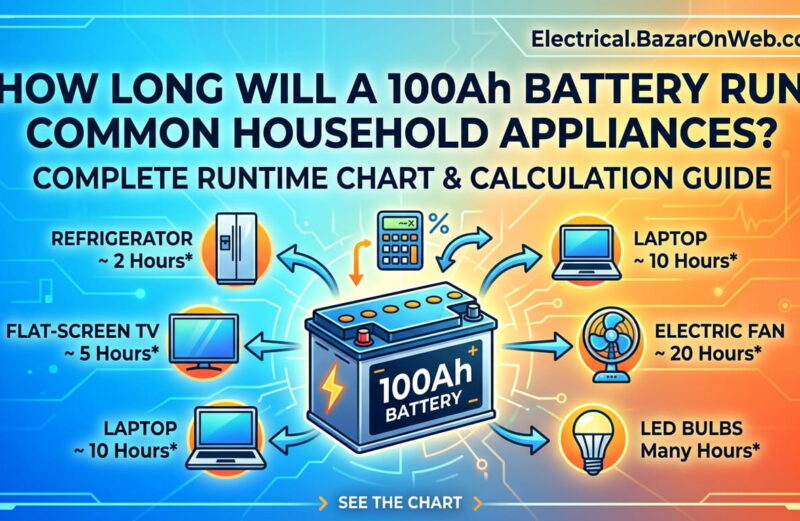
Hello, I’m Sudeep, and one of the most common questions I receive from homeowners, solar users, RV owners, and backup power enthusiasts is: “How long will a 100Ah battery run my appliances?” Whether you’re planning for a power outage, setting up a solar system, or using an inverter at home, understanding battery runtime helps you avoid surprises and maximize battery life.
A 100Ah battery is among the most popular battery capacities available today because it offers a good balance between affordability, portability, and backup power. However, the actual runtime depends on several factors, including battery voltage, appliance wattage, inverter efficiency, battery type, and allowable depth of discharge.
In this comprehensive guide, I’ll explain how to calculate runtime, provide easy-to-understand charts, discuss real-life examples, and help you estimate how long your 100Ah battery can power common household appliances. By the end of this article, you’ll be able to calculate battery backup for almost any electrical device confidently.
1. What Does a 100Ah Battery Actually Mean?
A battery rated at 100Ah (Ampere-hours) means it can theoretically deliver 100 amps for one hour, 10 amps for 10 hours, or 5 amps for 20 hours under ideal conditions. However, this rating alone does not tell the complete story because voltage also plays an important role.
Battery energy is measured in Watt-hours (Wh).
Formula:
Battery Capacity (Wh) = Voltage × Ah
Examples:
- 12V 100Ah Battery = 1,200Wh
- 24V 100Ah Battery = 2,400Wh
- 48V 100Ah Battery = 4,800Wh
This means a 100Ah battery can store different amounts of energy depending on its voltage.
Most homes using inverters typically use 12V or 24V batteries, while solar installations often use 48V battery banks for improved efficiency.
It’s also important to note that batteries should not always be discharged completely. Lead-acid batteries generally perform best when only 50% of their capacity is used regularly, while lithium batteries can safely use around 90–95% of their capacity.
Therefore, although a 12V 100Ah battery stores around 1,200Wh, the usable energy may be:
- Lead Acid: approximately 600Wh
- Lithium: approximately 1,080Wh
Understanding these basics is essential before estimating appliance runtime.
2. Formula to Calculate Battery Runtime
Battery runtime calculations are actually quite straightforward.
The basic formula is:
Runtime (Hours) = Battery Capacity (Wh) ÷ Appliance Power (Watts)
However, inverter efficiency should also be considered.
A more realistic formula is:
Runtime = Battery Capacity × Inverter Efficiency ÷ Appliance Wattage
Assume:
- Battery: 12V 100Ah
- Capacity: 1,200Wh
- Inverter Efficiency: 90%
Usable energy:
1,200 × 0.90 = 1,080Wh
Now consider different appliances.
100W appliance:
1,080 ÷ 100 = 10.8 hours
200W appliance:
1,080 ÷ 200 = 5.4 hours
500W appliance:
1,080 ÷ 500 = 2.16 hours
For lead-acid batteries using only 50% capacity:
600Wh usable energy
100W appliance:
600 ÷ 100 = 6 hours
This simple calculation gives a much more realistic estimate than relying solely on the Ah rating.
Always remember that higher power consumption means shorter battery backup.
3. Factors That Affect Battery Runtime
Many people expect identical backup times from every 100Ah battery, but several factors influence actual performance.
Battery Type
Lithium batteries provide more usable energy than lead-acid batteries.
Battery Age
Older batteries gradually lose capacity.
Temperature
Cold weather reduces battery efficiency.
Inverter Efficiency
Most inverters operate between 85% and 95% efficiency.
Appliance Startup Load
Devices with motors require higher starting current.
Depth of Discharge
Lead-acid batteries:
Recommended 50%
Lithium batteries:
Up to 90–95%
Continuous vs Intermittent Loads
A refrigerator cycles ON and OFF.
Fans also operate at different speeds.
Televisions vary brightness.
Therefore actual backup is often longer than theoretical calculations.
Battery Quality
Premium batteries generally maintain their capacity longer and deliver more consistent performance than low-quality alternatives.
Considering these variables provides a much more accurate expectation of battery runtime.
4. Runtime Chart for Common Household Appliances
Below is an approximate runtime chart using a 12V 100Ah Lithium Battery with 90% usable capacity and 90% inverter efficiency.
| Appliance | Power | Approx Runtime |
|---|---|---|
| LED Bulb | 10W | 100+ Hours |
| WiFi Router | 12W | 90 Hours |
| Ceiling Fan | 60W | 18 Hours |
| LED TV | 80W | 13 Hours |
| Laptop | 65W | 16 Hours |
| Desktop Computer | 200W | 5 Hours |
| Refrigerator | 150W Average | 7 Hours |
| Mixer Grinder | 500W | 2 Hours |
| Washing Machine | 400W | 2.5 Hours |
| Microwave | 1000W | 1 Hour |
| Water Pump | 750W | 1.4 Hours |
| Air Cooler | 180W | 6 Hours |
These values are approximate and may vary depending on appliance efficiency, operating conditions, and battery health.
5. How Long Can a 100Ah Battery Run Lights and Fans?
Lighting and ceiling fans are among the most common loads during power outages.
Suppose your home uses:
- Four LED bulbs (10W each)
- Two ceiling fans (60W each)
Total load:
40W + 120W = 160W
Usable battery energy:
1,080Wh
Runtime:
1,080 ÷ 160 = 6.75 hours
If using a lead-acid battery with only 600Wh usable:
600 ÷ 160 = 3.75 hours
Replacing older 20W LED bulbs with modern 9W models can significantly extend backup time.
Similarly, BLDC ceiling fans consume only 28–35W compared to traditional fans using 70–80W.
Upgrading to energy-efficient appliances greatly improves battery backup without increasing battery size.
6. Can a 100Ah Battery Run a Refrigerator?
Yes, but runtime depends on the refrigerator’s efficiency.
Most modern refrigerators consume:
100–250W while running.
However, compressors cycle ON and OFF.
Average consumption is often around:
100–150W.
Example:
Average load = 120W
Battery energy:
1,080Wh
Runtime:
1,080 ÷ 120 = 9 hours
Since compressors don’t run continuously, real-world backup may extend to 10–14 hours, depending on ambient temperature, door usage, and insulation.
Older refrigerators generally consume much more power and reduce battery runtime.
Always ensure your inverter can handle the refrigerator’s startup surge.
7. Will a 100Ah Battery Run an Air Conditioner?
Air conditioners are among the highest power-consuming household appliances.
Typical consumption:
- 1 Ton Inverter AC: 700–1,100W
- 1.5 Ton Inverter AC: 1,000–1,500W
- Window AC: 900–1,600W
Example:
800W average load
Battery energy:
1,080Wh
Runtime:
1.35 hours
Lead-acid battery:
Less than one hour.
Additionally, AC compressors require high startup current, meaning many small inverters may trip during startup.
For air conditioners, homeowners usually require multiple batteries connected in larger battery banks or dedicated solar energy storage systems.
Therefore, a single 100Ah battery is generally unsuitable for long-duration AC operation.
8. Tips to Increase Battery Backup Time
If you want your battery to last longer during outages, consider these practical tips.
Replace traditional fans with BLDC fans.
Use LED lighting throughout your home.
Turn off appliances that are not essential.
Use energy-efficient refrigerators.
Choose a high-efficiency pure sine wave inverter.
Keep batteries fully charged.
Avoid deep discharging lead-acid batteries.
Regularly clean battery terminals.
Maintain proper ventilation.
Avoid excessive heat.
Invest in quality batteries from reputable manufacturers.
Combine battery backup with rooftop solar to recharge during daylight.
These simple improvements can increase practical runtime by several hours without purchasing additional batteries.
9. Lead Acid vs Lithium 100Ah Battery Runtime Comparison
Although both batteries may be rated at 100Ah, their usable capacity differs greatly.
Lead Acid
- Lower purchase cost
- 50% recommended discharge
- Heavier
- Shorter lifespan
- Longer charging time
Lithium
- Higher usable capacity
- 90–95% discharge
- Lightweight
- Faster charging
- Longer service life
- Better efficiency
Example:
Stored Energy:
Both = 1,200Wh
Usable Energy:
Lead Acid:
600Wh
Lithium:
1,080Wh
Therefore, a lithium battery may provide nearly 80% more usable runtime than a comparable lead-acid battery under normal operating conditions.
While lithium batteries have a higher initial cost, they often deliver better long-term value due to their longevity and superior performance.
10. Frequently Asked Runtime Examples
Let’s answer some common questions.
How long will a 100Ah battery run a 100W appliance?
Approximately 10–11 hours (lithium).
How long will it run a 50W fan?
Around 20 hours.
Can it power a television?
Yes.
An 80W LED TV can operate for approximately 13 hours.
Can it run a laptop?
Certainly.
Most laptops consume between 45W and 90W.
Can it run a washing machine?
Yes, but only for a few cycles because washing machines draw relatively high power.
Can it power an induction cooktop?
Only briefly, as induction cooktops typically consume 1,500–2,000W.
Can I connect multiple batteries?
Absolutely.
Connecting batteries in series or parallel increases available energy and extends runtime, provided the system is designed correctly.
Understanding these examples makes it easier to estimate backup time for virtually any appliance.
Conclusion
A 100Ah battery is an excellent choice for home backup, solar energy systems, RVs, and emergency power applications. However, its runtime depends on more than just the battery’s amp-hour rating. Voltage, battery chemistry, inverter efficiency, appliance wattage, and depth of discharge all influence how long your appliances will operate.
For light household loads such as LED bulbs, fans, WiFi routers, and televisions, a 100Ah battery can provide several hours of reliable backup. High-power appliances like air conditioners, microwaves, induction cooktops, and water pumps will significantly reduce runtime and may require larger battery banks.
By learning the simple runtime formula and choosing energy-efficient appliances, you can make informed decisions about battery sizing and avoid unexpected power interruptions. Whether you’re planning a solar installation or preparing for outages, understanding battery capacity is the first step toward a dependable backup power system.