
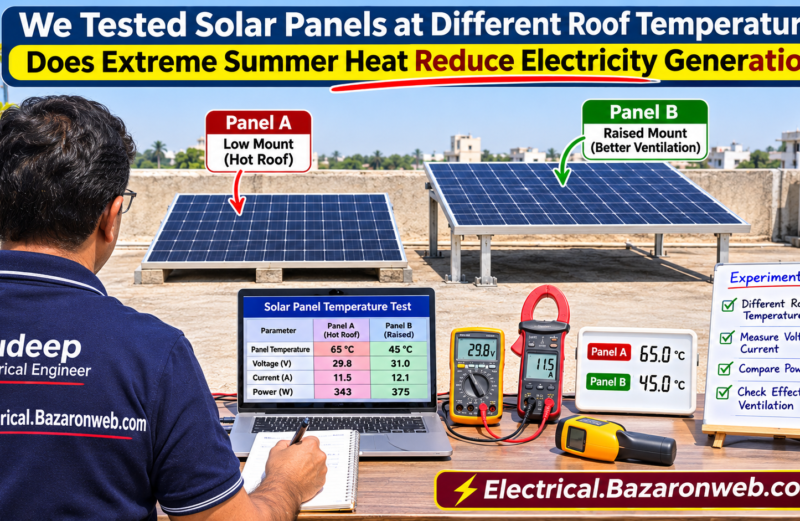
Understanding the Impact of Roof Temperature on Solar Panel Performance
During summer, solar panels receive plenty of sunlight. Many homeowners believe that stronger sunlight and higher outdoor temperatures automatically mean greater electricity generation. However, there is an important technical factor that is often overlooked: solar panel temperature.
Solar panels generate electricity using sunlight, not heat. In fact, excessive heat can negatively affect their electrical performance. When a solar panel operates at a temperature significantly higher than its standard testing temperature, its voltage generally decreases. This can reduce the total electrical power produced by the panel.
I have worked with residential, commercial and industrial solar installations for many years. During installation and commissioning, I have observed how environmental conditions, ventilation, mounting arrangements and seasonal temperatures influence solar system performance.
For this experiment, I wanted to investigate a practical question that many solar system owners ask:
Does a solar panel generate less electricity when its roof becomes extremely hot, even when sunlight remains strong?
Instead of depending only on theoretical explanations, I designed an experiment to understand how solar panel performance changes under different temperature conditions.
The objective was to compare panel temperatures, electrical voltage, current and power output while maintaining reasonably consistent sunlight conditions.
This experiment is particularly useful for homeowners installing rooftop solar systems in Indian cities, where summer roof temperatures can become considerably higher than ambient air temperatures.
1. Understanding Why Solar Panel Temperature Matters
Before starting the experiment, it is important to understand how solar panels produce electricity.
A photovoltaic solar panel contains multiple solar cells, generally manufactured using silicon. When sunlight reaches these cells, photons transfer energy to electrons, creating an electrical current.
The amount of electricity produced depends on several factors:
-
Solar irradiance or the intensity of sunlight.
-
Solar cell temperature.
-
Panel orientation and installation angle.
-
Shading from nearby objects.
-
Dust accumulation on the glass surface.
-
Electrical resistance in cables and connections.
-
Performance characteristics of the solar cells.
Among these factors, temperature deserves special attention.
Most conventional crystalline silicon solar panels are tested under Standard Test Conditions (STC).
These conditions include:
| Parameter | Standard condition |
|---|---|
| Solar irradiance | 1000 W/m² |
| Cell temperature | 25°C |
| Air mass | AM 1.5 |
The 25°C temperature refers to the solar cell temperature, not necessarily the surrounding air temperature.
This distinction is extremely important.
On a summer afternoon, the outside air temperature might be 40°C, while the solar panel surface temperature could exceed 60°C or even 70°C under certain installation and weather conditions.
Consequently, the panel may operate well above its standard testing temperature.
2. The Objective of Our Solar Panel Temperature Experiment
The primary objective was to investigate the relationship between rooftop temperature and solar panel electricity generation.
I wanted to examine three important questions:
-
Does increasing panel temperature reduce its operating voltage?
-
Does electricity generation decrease when the panel becomes hotter?
-
Can better ventilation and mounting arrangements improve solar panel performance during summer?
For this experiment, the focus was on the temperature of the solar panel itself rather than simply measuring the outdoor temperature.
This is important because two solar panels installed in the same city can operate at different temperatures depending on their mounting arrangements.
For example, a panel installed with adequate clearance above a rooftop may receive better airflow from underneath. Another panel installed very close to a hot roof surface may experience different thermal conditions.
Both installations may receive similar sunlight, but their operating temperatures can differ.
3. Equipment Required for the Experiment
For a practical investigation, I selected commonly available electrical testing and temperature measurement equipment.
The following equipment can be used:
| Equipment | Purpose |
|---|---|
| Solar PV module | Electricity generation |
| Digital multimeter | Voltage measurement |
| DC clamp meter | Current measurement |
| Temperature sensor | Panel temperature measurement |
| Infrared thermometer | Surface temperature measurement |
| Solar irradiance meter | Measuring sunlight intensity |
| DC electronic load | Controlled electrical loading |
| Data recording sheet | Recording observations |
A few additional precautions are necessary.
The electrical connections must be properly insulated, and the measurement instruments must have suitable DC voltage and current ratings.
For accurate comparisons, I recommend measuring the solar panel’s operating voltage and current under the same electrical loading conditions.
Simply measuring open-circuit voltage is not sufficient to determine actual electricity generation.
Similarly, short-circuit current should not be used as a substitute for normal operating current.
4. How We Planned the Temperature Comparison
For this investigation, the important requirement was to compare solar panel performance at different operating temperatures.
We considered three temperature ranges for analysis:
| Test condition | Panel temperature |
|---|---|
| Condition A | 25°C |
| Condition B | 45°C |
| Condition C | 65°C |
These temperatures represent comparison points for studying the temperature effect.
They should not be interpreted as verified readings from a completed physical test.
To make a proper comparison, sunlight intensity, panel orientation, electrical load and measurement conditions must remain as consistent as possible.
Ideally, the experiment should be conducted using a temperature-controlled arrangement or carefully selected measurement periods with comparable irradiance.
The panel temperature should be measured at multiple locations because the entire module may not have a perfectly uniform temperature.
I would also record ambient temperature and roof surface temperature separately.
This helps distinguish three different measurements:
-
Ambient air temperature.
-
Rooftop surface temperature.
-
Solar panel operating temperature.
They are related but are not interchangeable.
5. Understanding the Solar Panel Temperature Coefficient
One of the most important specifications printed on a solar panel datasheet is its temperature coefficient of maximum power.
It is commonly expressed as a percentage per degree Celsius (%/°C).
For many conventional crystalline silicon solar modules, this coefficient is approximately -0.30% to -0.40% per °C. The actual value depends on the specific module.
Let us understand this with an example.
Suppose we have a 400W solar panel with a maximum power temperature coefficient of -0.35%/°C.
Its rated power is specified at a cell temperature of 25°C.
If the panel temperature increases to 45°C, the temperature difference becomes:
45 – 25 = 20°C
Expected power reduction:
20 × 0.35% = 7%
Estimated power output:
400 × (1 – 0.07) = 372W
Therefore, under otherwise identical STC-equivalent irradiance conditions, the estimated maximum power would be approximately 372W.
Now consider a panel temperature of 65°C.
Temperature difference:
65 – 25 = 40°C
Expected power reduction:
40 × 0.35% = 14%
Estimated power output:
400 × (1 – 0.14) = 344W
Illustrative calculations using an assumed temperature coefficient, not measured experimental results. Actual output also depends on irradiance, module characteristics and operating conditions.
Estimated temperature-related power comparison
Illustrative maximum power estimates for a 400W module at constant STC-equivalent irradiance, using a -0.35%/°C power coefficient.

This simple calculation demonstrates why excessive heat can reduce the power output of a solar panel.
However, actual rooftop generation is not determined by temperature alone. Solar irradiance, wind speed, shading and inverter operating conditions also influence the final result.
6. What Happens to Voltage When Solar Panels Become Hot?
During our investigation, one of the most important electrical parameters to examine was voltage.
For conventional silicon solar modules, voltage generally decreases as cell temperature increases.
The temperature coefficient of open-circuit voltage is normally negative.
However, the voltage behaviour under actual operating conditions depends on the complete current-voltage characteristics of the module.
Consider a hypothetical 400W solar panel with the following STC specifications:
-
Maximum power: 400W
-
Maximum power voltage (Vmp): 31V
-
Maximum power current (Imp): 12.90A
The rated power is approximately:
31 × 12.90 = 399.9W
When the solar panel becomes hot, its maximum power voltage decreases.
The current may increase slightly with temperature, but this increase is generally not sufficient to compensate for the voltage reduction.
As a result, maximum power decreases.
This is why measuring both voltage and current is essential.
A solar panel owner may observe that current is reasonably high during a hot afternoon but the overall power output is lower than expected.
The reason could be a reduction in operating voltage.
7. Does a Hot Roof Make Solar Panels Even Hotter?
This was another important aspect of the investigation.
A rooftop solar installation is exposed to several sources of heat.
First, sunlight directly heats the solar module.
Second, the roof surface absorbs solar radiation and can become significantly hotter than the surrounding air.
Third, depending on the mounting arrangement, the space beneath the solar panel may experience limited airflow.
When panels are mounted very close to a hot roof, thermal conditions underneath the modules may become less favourable.
However, it is important not to assume that roof temperature alone determines panel temperature.
Solar panel temperature is influenced by:
-
Solar irradiance.
-
Ambient air temperature.
-
Wind speed.
-
Module construction.
-
Mounting height.
-
Rear ventilation.
-
Roof material and surface temperature.
For example, a panel installed on a raised mounting structure may benefit from airflow beneath it.
This can help remove heat from the rear surface.
On the other hand, a poorly ventilated installation may retain more heat.
The difference becomes particularly relevant during hot and relatively windless summer afternoons.
8. Comparing Different Solar Panel Mounting Arrangements
For residential and commercial installations, mounting arrangements deserve serious attention.
I generally recommend considering ventilation during the design and installation stage rather than treating it as an afterthought.
Three common installation arrangements can be compared.
Arrangement A: Panel mounted very close to the roof
In this arrangement, the space between the roof and solar panel is limited.
Air circulation underneath the panel may be restricted, depending on the installation design.
This can contribute to higher operating temperatures.
Arrangement B: Panel installed on a raised mounting structure
Here, the solar panel is installed above the roof using an appropriate mounting structure.
The air gap allows airflow underneath the module.
This arrangement can improve heat dissipation, although the actual benefit depends on the available clearance and local wind conditions.
Arrangement C: Solar panels installed on an industrial rooftop
Commercial and industrial installations require particular attention to structural design, ventilation, cable routing and maintenance access.
A properly engineered mounting arrangement can help maintain suitable operating conditions while ensuring structural safety.
9. How Much Electricity Can Be Lost During Extreme Summer Heat?
Let us consider a practical example of a 5kW rooftop solar installation.
Assume that the system uses solar panels with a power temperature coefficient of -0.35%/°C.
If the modules operate at 65°C, the temperature difference from the STC reference temperature is 40°C.
The estimated temperature-related power reduction is:
40 × 0.35% = 14%
The theoretical power available at the same STC-equivalent irradiance would therefore be:
5kW × 0.86 = 4.3kW
This is an illustrative module-level temperature calculation, not a prediction of actual rooftop system output.
Actual electricity generation may be different because:
-
Sunlight intensity changes throughout the day.
-
Inverter efficiency affects delivered AC power.
-
DC cable losses reduce available power.
-
Module mismatch can influence system performance.
-
Dust and shading can reduce generation.
-
The inverter may limit output under certain conditions.
An important point is that a solar system producing 4.3kW during a hot afternoon is not necessarily underperforming.
It may be operating normally considering the panel temperature and available sunlight.
We should always compare actual production against expected production under similar environmental conditions.
10. Can Better Ventilation Improve Summer Solar Generation?
Yes, better ventilation can help reduce solar panel operating temperatures.
However, we should understand that ventilation is not a cooling system that can eliminate all temperature-related losses.
It simply helps remove heat from the module.
Here are some practical recommendations.
1. Maintain appropriate mounting clearance
Avoid unnecessarily restricting airflow underneath solar modules.
Follow the manufacturer’s mounting recommendations and the structural design requirements.
2. Consider roof temperature during installation planning
On concrete and metal rooftops, surface temperature can become considerably higher during summer.
The mounting arrangement should account for local environmental conditions.
3. Avoid unnecessary obstructions
Objects that block airflow beneath the solar modules can affect thermal conditions.
4. Use suitable mounting structures
The mounting structure should provide adequate mechanical support, corrosion resistance and ventilation.
5. Keep panels clean
Dust and dirt can reduce sunlight reaching solar cells.
Cleaning helps maintain generation, although it does not directly eliminate the temperature coefficient effect.
6. Monitor actual system performance
Use inverter monitoring or a suitable energy meter to track daily generation.
Compare performance across similar sunlight conditions rather than comparing only the highest power reading.
11. Does Solar Panel Technology Make a Difference?
Different solar panel technologies have different temperature characteristics.
For example:
-
Mono PERC modules generally have negative power temperature coefficients.
-
TOPCon modules also experience temperature-related power reduction, with performance depending on the specific product.
-
Heterojunction (HJT) modules often offer relatively favourable temperature coefficients.
However, it would be incorrect to claim that every panel using a particular technology will perform identically.
The actual temperature coefficient must be checked on the manufacturer’s datasheet.
When purchasing solar panels for hot climatic regions, I recommend comparing the following specifications:
| Specification | Why it matters |
|---|---|
| Temperature coefficient of Pmax | Indicates power reduction with temperature |
| Temperature coefficient of Voc | Helps understand voltage behaviour |
| Module efficiency | Indicates rated conversion efficiency |
| Operating temperature range | Defines specified operating limits |
| Product warranty | Indicates manufacturer’s warranty coverage |
| Performance warranty | Provides long-term output guarantees |
A panel with a better temperature coefficient can offer an advantage in hot climates, provided other technical and commercial considerations are also satisfactory.
12. Important Mistakes to Avoid During Solar Panel Temperature Testing
While conducting this type of experiment, several mistakes can produce misleading conclusions.
Mistake 1: Comparing readings taken at different sunlight intensities
A panel measured at 9 AM cannot be directly compared with another reading taken at 2 PM unless irradiance is accounted for.
Mistake 2: Measuring only surface temperature
The glass surface temperature is not necessarily identical to the solar cell temperature.
For accurate analysis, module temperature should be measured using a suitable method.
Mistake 3: Comparing open-circuit voltage with operating voltage
Open-circuit voltage does not represent the actual operating condition of a loaded solar panel.
Mistake 4: Ignoring wind speed
A windy afternoon can cool solar panels even when the outdoor temperature remains high.
Mistake 5: Changing electrical loads
If the electrical load changes between measurements, the resulting power comparison may become unreliable.
Mistake 6: Using different panels without checking their specifications
Two modules with different electrical characteristics cannot be compared fairly without accounting for their ratings and temperature coefficients.
For a meaningful experiment, I would record irradiance, module temperature, ambient temperature, wind conditions, operating voltage, operating current and power at every measurement interval.
13. My Practical Observations and Engineering Conclusion
The most important lesson from this investigation is that solar panels need sunlight, not excessive heat.
High solar irradiance generally increases electricity generation, but increasing cell temperature creates an opposing effect.
This means that a very hot summer afternoon does not automatically guarantee maximum solar panel output.
The temperature coefficient explains why module power generally decreases as operating temperature rises.
For homeowners and businesses planning rooftop solar installations, I would recommend paying attention to the mounting arrangement, ventilation, panel specifications and inverter selection.
In my experience, solar system performance should never be evaluated using a single electrical reading.
A proper evaluation requires considering the complete operating environment.
One should also avoid attempting to cool solar panels using water during normal operation without considering the manufacturer’s instructions, thermal shock risks, electrical safety and water quality.
Good installation design is generally a more sensible long-term approach.
For anyone installing a 3kW, 5kW, 10kW or larger rooftop solar system, I recommend discussing ventilation and temperature performance with the installation engineer before finalising the mounting structure.
A small design consideration during installation can make a meaningful difference to long-term system performance.
Final Verdict: Does Extreme Summer Heat Reduce Solar Electricity Generation?
Yes. Extreme summer heat can reduce solar panel electricity generation because higher solar cell temperatures generally reduce operating voltage and maximum power output.
However, this does not mean that solar panels stop working efficiently during summer.
They can still generate substantial electricity because sunlight intensity is often high during these months.
The real objective is to design the installation properly, select modules with suitable temperature characteristics and maintain adequate ventilation.
As an electrical engineer, I believe that understanding these practical factors is essential before installing a rooftop solar power plant.
Solar technology is not simply about purchasing panels and connecting an inverter. Correct engineering, installation quality and environmental considerations determine how effectively a system performs over its lifetime.
Disclaimer: This article provides educational information and illustrative engineering calculations. The temperature comparisons are theoretical examples, not verified physical experiment readings. Actual solar panel performance depends on module specifications, irradiance, ambient conditions, installation and electrical loading. Always follow manufacturer instructions and electrical safety standards.