
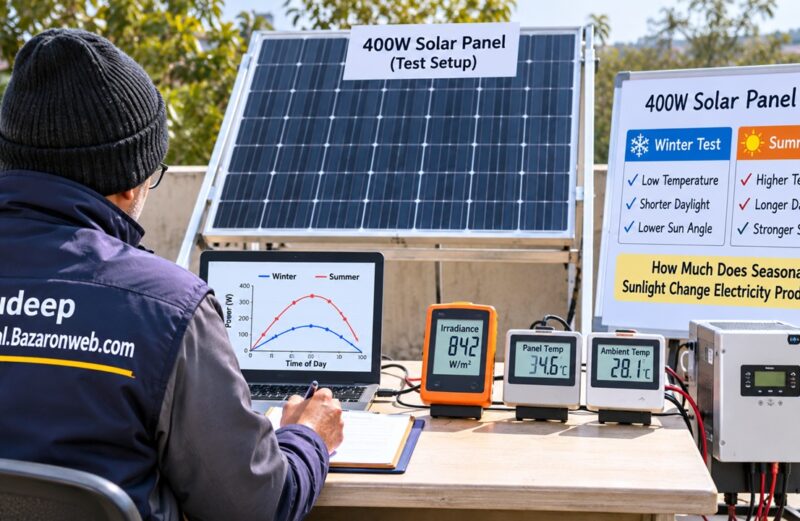
Solar panels are often advertised with a fixed power rating, such as 400 watts, 450 watts, or 550 watts. However, anyone who has worked with solar installations knows that a panel does not produce the same amount of electricity throughout the year. Seasonal changes in sunlight, temperature, daylight duration, cloud cover, and the angle of the sun can significantly influence its daily energy production.
During my years of working with solar power installations, I have observed an interesting relationship between temperature and solar electricity generation. Many people assume that solar panels perform better during summer simply because the days are longer and sunlight is stronger. However, there is another important factor: solar panels generally operate more efficiently at lower temperatures.
To understand this relationship, let’s examine a 400W solar panel under winter and summer operating conditions, using a practical engineering comparison. We will look at sunlight availability, panel temperature, peak power, daily electricity generation, and the factors that influence seasonal performance.
The objective is not simply to compare two seasons but to understand why a solar panel may produce more instantaneous power during a cool winter afternoon while generating more total electricity over a long summer day.
Understanding the 400W Solar Panel
Before comparing winter and summer performance, we need to understand what a 400W rating actually represents.
A 400W solar panel is rated to produce approximately 400 watts of electrical power under Standard Test Conditions (STC).
These conditions include:
- Solar irradiance: 1,000 W/m².
- Cell temperature: 25°C.
- Air mass: AM 1.5.
These are laboratory reference conditions, not necessarily the conditions experienced by a panel installed on a rooftop.
In an actual installation, the output depends on several variables, including sunlight intensity, solar angle, panel temperature, shading, dust accumulation, and electrical losses.
For example, a 400W panel operating under strong sunlight with relatively cool solar cells may approach its rated output. The same panel operating under high cell temperatures may produce considerably less power, even when sunlight intensity is excellent.
This distinction is particularly important for homeowners in the United States and Canada, where seasonal weather conditions can vary dramatically.
How We Compare Winter and Summer Performance
For this comparison, we consider a typical 400W monocrystalline solar panel installed outdoors with a fixed mounting structure.
The panel is assumed to have the same orientation, tilt, wiring configuration, and electrical equipment in both seasons.
The comparison focuses on two representative operating environments:
Winter conditions:
- Outdoor temperature between -5°C and 10°C.
- Shorter daylight hours.
- Lower average solar elevation.
- Potential snow accumulation and cloudy weather.
- Relatively cool solar cell temperatures.
Summer conditions:
- Outdoor temperature between 25°C and 35°C.
- Longer daylight hours.
- Higher average solar elevation.
- Greater potential daily sunlight availability.
- Higher solar cell operating temperatures.
These are illustrative conditions, not recorded measurements from a specific test location. Actual winter and summer results depend on the geographical location, weather, installation angle, and local solar resource.
An important point in this comparison is that we should distinguish between instantaneous power output, measured in watts, and total daily energy production, measured in kilowatt-hours.
A panel can produce more watts at a particular moment but still generate fewer kilowatt-hours throughout the day.
Experiment 1: Does a Solar Panel Produce More Power in Winter?
One of the most interesting characteristics of photovoltaic technology is its temperature response.
Unlike many electrical devices, solar panels generally become less efficient as their operating temperature increases.
Most crystalline silicon solar panels have a negative power temperature coefficient. Depending on the particular module, this is commonly around -0.30% to -0.40% per degree Celsius.
Let’s consider a 400W solar panel with a temperature coefficient of -0.35% per °C.
At the laboratory reference temperature of 25°C, the panel has a rated output of 400W.
Now imagine the solar cells reach 65°C during a hot summer afternoon.
The temperature difference is:
65°C – 25°C = 40°C.
The estimated power reduction is:
40 × 0.35% = 14%.
The temperature-adjusted output, assuming 1,000 W/m² irradiance, becomes:
400W × (1 – 0.14) = 344W.
Therefore, the panel may produce approximately 344W under these assumed conditions.
Now consider the same panel operating at a solar cell temperature of 15°C.
The temperature difference is:
15°C – 25°C = -10°C.
The estimated temperature-related power increase is:
10 × 0.35% = 3.5%.
The estimated output becomes:
400W × 1.035 = 414W.
This calculation demonstrates something important: a 400W solar panel can temporarily exceed its rated STC power under favorable conditions.
However, this does not mean winter always produces more electricity. The calculation assumes identical irradiance and does not account for the shorter winter day or changing sunlight intensity.
Experiment 2: Comparing Daily Electricity Production
Now let’s examine the difference between instantaneous output and total daily energy generation.
For homeowners, daily energy production is generally more important than the maximum wattage displayed on an inverter.
Consider a hypothetical 400W solar panel installed in two different seasonal environments.
The following figures are illustrative energy-yield scenarios, not actual measured test results.
Winter scenario
Assume the panel receives approximately 2.5 peak sun hours per day.
The estimated daily energy production before system losses is:
0.4 kW × 2.5 hours = 1.0 kWh.
If we consider approximately 15% combined system losses:
1.0 × 0.85 = 0.85 kWh.
The estimated daily production becomes approximately 0.85 kWh.
Summer scenario
Now assume the panel receives approximately 5.5 peak sun hours per day.
The estimated daily energy production before system losses is:
0.4 kW × 5.5 hours = 2.2 kWh.
After applying the same 15% system losses:
2.2 × 0.85 = 1.87 kWh.
The estimated daily production becomes approximately 1.87 kWh.
<escape>These examples show how a panel can generate considerably more total electricity in summer, even though its operating efficiency may be lower because of higher temperatures.</escape>
The actual difference could be smaller or larger depending on the location.
Experiment 3: The Impact of Solar Cell Temperature
Outdoor air temperature and solar cell temperature are not the same thing.
This is something I always emphasize when discussing solar system performance.
A solar panel absorbs sunlight and converts only a portion of that energy into electricity. The remaining absorbed energy contributes to heating the module.
Consequently, a panel installed on a rooftop can become considerably hotter than the surrounding air.
For example, during a summer afternoon:
- Outdoor air temperature: 32°C.
- Solar panel cell temperature: 60°C.
- Temperature difference: 28°C.
Using a temperature coefficient of -0.35% per °C, the estimated temperature-related power reduction is:
28 × 0.35% = 9.8%.
This means the panel could lose approximately 9.8% of its rated power due to temperature alone under otherwise identical irradiance conditions.
In winter, the situation can be different.
A panel exposed to strong sunlight with an outdoor temperature of 5°C may have a much lower operating cell temperature than a comparable summer installation.
The lower cell temperature can improve conversion efficiency.
However, cold weather does not automatically guarantee high output. If clouds reduce solar irradiance, the panel cannot compensate for the missing sunlight simply because its temperature is low.
Why Winter Solar Production Is Often Lower in the USA and Canada
Geographical location plays a major role in seasonal solar production.
In many parts of the United States and Canada, winter brings shorter days and a lower solar elevation.
When the sun travels lower across the sky, sunlight reaches a fixed solar panel at a different angle. This can reduce the amount of solar energy captured by the module.
There are several additional factors.
1. Shorter daylight hours
During winter, sunrise occurs later and sunset occurs earlier. The panel has fewer daylight hours available to generate electricity.
2. Lower solar elevation
The sun follows a lower path across the sky in winter. Fixed rooftop installations may receive less favorable sunlight during some parts of the day.
3. Snow accumulation
Snow covering the front surface of a solar panel can block sunlight and significantly reduce electricity production. Even partial coverage can affect output depending on the module’s electrical design.
4. Cloud cover
Winter weather in locations such as the Pacific Northwest, the Great Lakes region, and parts of eastern Canada can bring extended cloudy periods.
5. Frost and ice
Frost, ice, and accumulated snow can interfere with normal panel operation. Their impact depends on the extent of coverage and local weather conditions.
Interestingly, a clean solar panel can perform quite efficiently during a clear winter day. The challenge is usually the reduced availability of sunlight rather than cold temperatures themselves.
Does Summer Always Produce More Electricity?
Not necessarily.
A common misconception is that the hottest summer days are automatically the best days for solar power generation.
In reality, solar panels need sunlight, not extreme heat.
A clear spring day with moderate temperatures can sometimes provide excellent solar generation because sunlight intensity is strong while panel operating temperatures remain relatively low.
Similarly, an extremely hot summer afternoon may produce less instantaneous power than expected because of temperature-related efficiency losses.
Another important factor is the installation environment.
Panels installed close to a roof surface with limited airflow may experience higher operating temperatures than panels mounted with adequate ventilation.
This is why mounting design, rear ventilation, and installation quality matter.
For solar installers, considering only the panel’s rated wattage without understanding its temperature characteristics can lead to unrealistic production expectations.
How Solar Panel Orientation and Tilt Affect Seasonal Production
The mounting angle of a solar panel can influence its winter and summer performance.
In the Northern Hemisphere, including the United States and Canada, south-facing installations generally provide good annual solar exposure.
However, the ideal tilt angle depends on geographical latitude, roof configuration, shading, and the desired seasonal production profile.
A fixed panel optimized for annual energy production may not capture the maximum possible winter sunlight.
For example, increasing the tilt angle can sometimes improve winter performance because the sun remains lower in the sky. It can also help snow slide off the panel surface.
However, changing the tilt too much may reduce summer production.
In my experience with solar installations, the mounting structure should be designed according to the site’s actual requirements rather than relying on one universal tilt-angle formula.
Homeowners should also consider local snow loads, wind conditions, roof strength, and mounting-system specifications.
What About Solar Panel Efficiency During Snowy Weather?
Snow creates an interesting situation for solar installations.
When snow covers a solar panel, electricity production can drop significantly because sunlight cannot reach the photovoltaic cells effectively.
However, snow surrounding an installation can also reflect sunlight toward the panels.
This phenomenon is called the albedo effect.
On a clear winter day, reflected sunlight from snow-covered ground may increase the amount of light reaching a suitably positioned panel.
Bifacial solar panels can benefit particularly from reflected light because they are designed to generate electricity from both sides.
However, the benefit depends on panel elevation, ground reflectivity, installation design, and the amount of unobstructed light reaching the rear surface.
It is important not to confuse reflected sunlight benefits with the impact of snow covering the front of a panel. Front-side snow coverage can still cause substantial production losses.
How to Measure Seasonal Performance Correctly
If you want to compare your own 400W solar panel during winter and summer, I recommend following a consistent measurement process.
You do not need an expensive laboratory to begin collecting useful information.
A suitable monitoring setup can include:
- A solar panel with a known STC rating.
- A compatible MPPT charge controller or solar inverter.
- A DC energy meter.
- A temperature sensor attached to the rear surface of the module.
- A solar irradiance meter, if available.
- A data logger for recording measurements.
Record the following parameters:
- Date and time.
- Outdoor air temperature.
- Solar panel temperature.
- Solar irradiance.
- DC voltage.
- DC current.
- Instantaneous power.
- Total daily energy production.
Remember that voltage multiplied by current gives electrical power in watts:
Power (W) = Voltage (V) × Current (A).
For example, if a panel produces 38V and 9A:
38 × 9 = 342W.
For meaningful seasonal comparisons, measurements should be taken at consistent intervals and under clearly documented conditions.
Ideally, compare daily energy production over several weeks rather than relying on one sunny day.
Also, use the same panel, inverter or charge controller, mounting orientation, and measurement equipment wherever possible.
Practical Recommendations for Solar Owners in the USA and Canada
Seasonal variations should be considered when designing residential and commercial solar systems.
Here are some practical recommendations.
Keep panels clean: Dust, leaves, bird droppings, and other obstructions can reduce generation. Follow manufacturer-approved cleaning instructions.
Consider snow management: Ensure that the mounting structure is suitable for local snow loads. Never climb onto a slippery roof to remove snow.
Monitor daily production: Compare monthly energy generation rather than judging system performance using one day’s readings.
Provide adequate ventilation: Proper mounting clearance allows airflow behind the modules and can help reduce operating temperatures.
Check shading throughout the year: Trees and nearby structures may create longer shadows when the sun is lower in winter.
Use realistic production estimates: Solar system design should account for local solar irradiance, seasonal weather, orientation, tilt, and system losses.
For locations with substantial winter snow, homeowners should also understand that annual energy production and winter energy independence are two different design objectives.
A system that performs exceptionally well annually may still require grid electricity or battery backup during extended winter periods.
Final Verdict: Winter vs Summer Solar Production
After examining the temperature characteristics, solar irradiance, daylight duration, and seasonal installation conditions, one conclusion becomes clear: solar panel performance cannot be evaluated using temperature alone.
A 400W solar panel may achieve higher instantaneous output during a cool winter day than during a very hot summer afternoon, provided that both conditions have comparable solar irradiance.
However, summer generally offers longer daylight hours and, in many locations across the USA and Canada, greater daily solar energy availability.
Therefore, total daily and monthly electricity production is often higher during summer.
Winter performance can still be impressive when skies are clear, panels are free from snow, and the installation has a suitable orientation and tilt.
From an engineering perspective, I would never evaluate a solar installation by looking only at its rated wattage or peak output. The more useful measurement is how many kilowatt-hours the system generates over a complete day, month, and year.
For anyone planning a residential or commercial solar installation, understanding these seasonal variations is essential for selecting the right panel capacity, inverter, battery storage, and overall system configuration.
A 400W solar panel remains a 400W-rated module throughout the year, but the energy it delivers depends on the environment in which it operates.
That is the real difference between laboratory ratings and practical solar engineering.
About the Author
Sudeep is an Electrical Engineer with 25 years of experience in electrical engineering, solar power installations, engineering procurement, and commissioning. His practical experience includes residential, commercial, and industrial solar power systems, as well as battery manufacturing. He conducts electrical engineering experiments and shares practical observations to help homeowners, technicians, installers, and solar professionals understand how electrical and renewable energy systems perform in real-world conditions.
Disclaimer: This article provides an engineering comparison using illustrative operating conditions and calculations, not verified measurements from a specific winter-versus-summer field test. Actual solar production varies with location, weather, equipment specifications, installation design, and operating conditions. Always consult qualified professionals for system design and electrical work.