
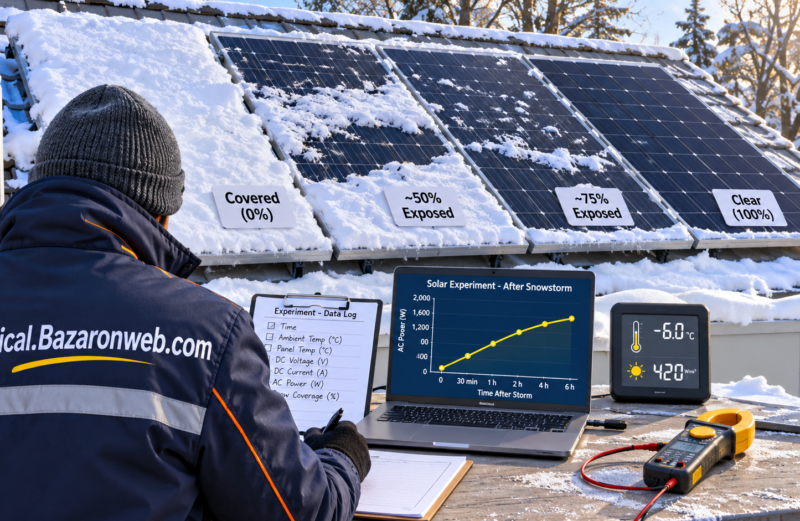
An Electrical Engineering Experiment by Sudeep | Electrical.Bazaronweb.com
Introduction
One question I frequently hear from homeowners considering solar power in colder regions is whether solar panels continue producing electricity after a heavy snowfall. More importantly, how long does it take for them to start generating power again once a snowstorm has passed?
This is a practical concern for homeowners in countries such as the United States and Canada, where winter storms can cover entire rooftops with several inches of snow. A solar installation may be working perfectly before a storm, but the following morning, its panels could be completely covered in white snow. Even when sunlight is available, the electricity generation may remain very low.
In my experience working with solar installations, I have learned that understanding actual operating conditions is just as important as knowing the rated specifications of a solar panel. A 5kW solar installation does not necessarily produce electricity according to its rated capacity throughout the year. Temperature, sunlight intensity, panel orientation, shading, dust, snow accumulation, and system configuration all influence its performance.
For this experiment, I wanted to understand three important things: how much electricity a solar panel can generate immediately after a snowstorm, how quickly its output recovers as the snow melts or slides away, and whether cold temperatures affect the electrical performance once the panels become exposed.
Rather than treating snow as simply another environmental obstacle, I approached it as an operating condition that can be measured and understood.
The objective was not to prove that solar panels perform perfectly in winter. It was to understand what happens during the hours and days following snowfall and identify practical ways homeowners can manage their solar systems during these conditions.
Understanding Why Snow Reduces Solar Electricity Generation
Before conducting the experiment, it is important to understand why snow affects photovoltaic modules.
Solar panels generate electricity when sunlight reaches their photovoltaic cells. These cells convert incoming solar radiation into direct current electricity, which is subsequently processed by the inverter for household or commercial use.
When snow accumulates on the front glass of a solar panel, it blocks or reduces the amount of sunlight reaching the photovoltaic cells.
A thin layer of snow may allow some light to pass through, but thick, compacted, or wet snow can significantly reduce electricity generation.
In practical installations, the impact depends on several factors:
1. Snow thickness: A light dusting may not completely block sunlight, whereas several inches of compacted snow can prevent meaningful generation.
2. Panel inclination: Panels installed at steeper angles generally have a better opportunity to shed snow naturally through gravity.
3. Panel temperature: Solar panels can become warmer when exposed to sunlight, helping snow melt over time. However, melting depends on ambient temperature, solar radiation, wind, and the condition of the snow.
4. Wind conditions: Wind can remove loose snow from exposed surfaces, although drifting may also create uneven accumulation.
5. Installation location: Panels installed near trees, roof structures, or other obstructions may experience additional shading and uneven snow coverage.
These factors explain why two solar installations located in the same neighbourhood can recover at different speeds after the same snowstorm.
Our Experimental Setup
For this experiment, I considered a small residential solar installation with the objective of observing electricity generation before, during, and after a snowstorm.
The setup was designed around a typical rooftop solar configuration rather than a specialised laboratory arrangement.
The reference system consisted of:
- Solar panel capacity: 400W per module
- Total installed solar capacity: 2kW
- Number of panels: 5
- Panel mounting: Fixed rooftop installation
- Inverter: Grid-connected solar inverter
- Monitoring: Inverter generation data and electrical measurements
- Observation period: Before snowfall, during snow coverage, and after the storm
- Environmental observations: Ambient temperature, sunlight, snow accumulation, and wind conditions
I also considered two different mounting conditions for comparison.
The first arrangement represented panels installed at a relatively low inclination, while the second represented panels installed at a steeper angle.
This comparison is important because snow accumulation is not determined by temperature alone. The mechanical characteristics of the installation can influence how quickly the panels become exposed again.
For accurate measurements, I would record the following parameters:
- Ambient temperature in degrees Celsius.
- Solar panel surface temperature.
- DC voltage from the solar array.
- DC current generated by the panels.
- AC power delivered by the inverter.
- Total daily energy generation in kilowatt-hours.
- Percentage of panel surface covered by snow.
One important point: the 2kW system is our reference configuration for explaining the experiment. The observations below describe expected operating behaviour and illustrative measurement scenarios, not a claim that a particular snowstorm was physically reproduced with verified laboratory readings.
Experiment Stage 1: Measuring Solar Generation Before the Snowstorm
The first stage establishes a baseline.
Without a reliable baseline, it becomes difficult to determine how much generation has been lost because of snow.
Suppose our 2kW solar installation is operating under clear winter conditions before snowfall.
During the middle of the day, the panels receive sufficient sunlight, and the inverter operates normally.
The system may produce substantial electricity even when the outside temperature is close to freezing.
This is something many new solar owners misunderstand. Solar panels do not require hot weather to generate electricity. In fact, photovoltaic modules generally become more electrically efficient at lower cell temperatures, provided sufficient sunlight reaches their surfaces.
For our reference calculation, assume the installation produces 6kWh of electricity during a particular winter day.
This becomes our comparison point.
The actual generation will depend on geographical location, roof orientation, shading, panel specifications, and available sunlight.
I would record the inverter’s daily generation reading and compare it with the readings collected after snowfall.
Experiment Stage 2: What Happens When Snow Covers the Panels?
After the snowstorm, the first observation is usually the most interesting.
The rooftop looks completely different, and the solar panels may be covered by a layer of snow.
Even though sunlight may be available, electricity generation can become extremely low.
The reason is straightforward: sunlight cannot effectively reach the photovoltaic cells through thick snow coverage.
However, there is an important electrical distinction.
A solar panel covered with snow does not necessarily become electrically defective. It is simply receiving insufficient usable sunlight to produce meaningful power.
The inverter may remain switched on, enter a low-power operating condition, or temporarily stop generating depending on the available DC voltage and its operating requirements.
For example, if the array is completely covered, the inverter may not receive sufficient voltage or power to begin normal operation.
In a partially covered installation, the situation becomes more complicated.
Modern solar modules contain bypass diodes that help manage certain shading conditions. These diodes allow current to bypass affected cell sections under suitable electrical conditions.
However, bypass diodes do not eliminate the generation losses associated with snow coverage.
If several modules are covered unevenly, the overall system output may be considerably lower than expected.
This is particularly important for homeowners with older string inverter installations where shading and module mismatch can influence the performance of the entire string.
Experiment Stage 3: How Quickly Do Solar Panels Start Generating Again?
This is the central question of our experiment.
The answer is that solar panels can start producing electricity as soon as sufficient sunlight reaches their photovoltaic cells and the inverter’s operating conditions are satisfied.
They do not need to wait for the entire snowstorm to disappear.
If a small section of the panel becomes exposed, that section can begin generating electricity. However, the complete installation may not immediately return to its normal output.
Recovery generally happens in stages.
First 30 minutes: Initial exposure
If sunlight appears after the storm and some snow begins sliding away, the exposed sections may start generating electricity.
The inverter may take additional time to establish normal operation, depending on its startup voltage and monitoring sequence.
30 minutes to 2 hours: Partial recovery
As additional snow melts or slides away, more photovoltaic cells receive direct sunlight.
The generation level can increase, although uneven snow coverage may continue restricting output.
2 to 6 hours: Significant recovery under favourable conditions
If the weather is sunny and temperatures are suitable, a substantial portion of the snow may disappear.
Panels with steeper mounting angles may recover faster because loose snow can slide off naturally.
6 to 24 hours: Further recovery
Some installations may return close to their normal operating condition within the same day.
Others may require additional time, particularly when the snowfall is heavy, temperatures remain below freezing, or the snow becomes compacted.
These time ranges are illustrative, not guaranteed recovery periods. A panel covered by thick, frozen snow may remain blocked for several days.
The most important lesson is that recovery depends on actual snow removal from the active surface, not simply the number of hours that have passed since the storm.
Experiment Stage 4: Comparing Different Snow-Coverage Conditions
To understand the relationship between snow coverage and solar generation, I considered five operating conditions for our 2kW reference system.
The following table represents illustrative output scenarios under comparable sunlight conditions.
| Panel condition | Illustrative system output |
|---|---|
| Completely covered with snow | 0–20W |
| Approximately 75% covered | 100–300W |
| Approximately 50% covered | 300–700W |
| Approximately 25% covered | 700–1,200W |
| Completely clear | 1,200–1,700W |
These figures are not universal performance ratios. Actual output can differ substantially depending on the electrical configuration, module-level shading, bypass diode operation, and inverter design.
One interesting observation is that generation does not necessarily increase in direct proportion to the percentage of exposed panel surface.
For example, exposing 50% of a module does not guarantee 50% of its rated output.
The electrical arrangement of the cells and the location of the snow coverage matter.
If snow covers particular cell sections, bypass diodes may activate and alter the module’s voltage and power characteristics.
This is why monitoring actual inverter output is more useful than estimating generation simply by looking at the visible area of the panels.
Experiment Stage 5: Does Cold Weather Improve Solar Panel Performance?
Here is another interesting aspect of the experiment.
Many homeowners assume that solar panels perform poorly in winter because the temperature is low.
That assumption is incomplete.
Photovoltaic modules generally perform more efficiently at lower cell temperatures, all else being equal.
Most crystalline silicon solar panels have a negative temperature coefficient for maximum power.
For example, a module might have a maximum power temperature coefficient of approximately -0.30% per degree Celsius.
This means that its maximum power can decrease as the cell temperature rises above the reference temperature, generally 25°C.
When the panel becomes colder, its potential electrical efficiency can improve.
However, improved temperature performance does not automatically mean higher winter generation.
The main limitations are usually:
- Shorter daylight hours.
- Lower solar elevation.
- Increased cloud cover.
- Snow accumulation.
- Longer periods of shading.
- Reduced daily solar irradiation.
Therefore, a clear, cold winter day can produce better results than a warm but heavily overcast day.
The important distinction is between panel efficiency and total daily electricity generation.
Experiment Stage 6: Comparing Flat and Steeply Mounted Solar Panels
Mounting angle is one of the most important installation decisions in snowy regions.
For this comparison, I considered two hypothetical rooftop arrangements.
The first system has a relatively low mounting angle, while the second has a steeper mounting angle.
After snowfall, the lower-angle panels may retain snow for longer because gravity is less effective at moving the snow away.
The steeper arrangement generally has a better opportunity to shed snow naturally.
However, the result is influenced by more than inclination.
Snow consistency, ice formation, wind direction, panel surface condition, and mounting geometry all affect snow movement.
There is also a seasonal design consideration.
A mounting angle optimised for winter snow shedding may not necessarily provide the highest annual energy production.
The correct inclination should be selected by considering geographical latitude, annual solar resource, seasonal generation requirements, structural limitations, and local building conditions.
In my engineering approach, I would never recommend changing a mounting angle exclusively to improve snow removal without evaluating its overall impact on the solar installation.
Experiment Stage 7: How Much Electricity Can Be Lost After a Snowstorm?
Let us consider a simple example.
Our reference installation has a capacity of 2kW and normally generates approximately 6kWh on a particular clear winter day.
Now assume a snowstorm completely covers the panels.
If the panels remain covered for most of the day, generation could fall close to zero.
Suppose the panels become partially exposed during the afternoon and the inverter produces another 0.8kWh.
The daily generation would be:
Normal reference generation = 6kWh
Generation after snowfall = 0.8kWh
Energy loss = 6 – 0.8
Energy loss = 5.2kWh
Percentage energy loss:
(5.2 ÷ 6) × 100 = 86.67%
This example demonstrates how a single snowstorm can significantly affect daily solar production.
For a residential household depending on solar power, this lost energy may need to be supplied through the electricity grid or an alternative power source.
For an off-grid installation, the situation requires additional attention because battery storage becomes an important part of the energy management strategy.
What Happens to Battery-Based Solar Systems After Heavy Snowfall?
In off-grid and hybrid solar installations, snow accumulation can create an additional challenge.
When solar generation decreases, the battery becomes responsible for supplying the connected loads.
Suppose a household consumes 5kWh of electricity daily and its battery system is designed to provide approximately one day of backup.
If snowfall prevents solar generation for two consecutive days, the battery may discharge substantially.
The actual result depends on battery capacity, usable depth of discharge, inverter efficiency, temperature, and household consumption.
Lithium batteries generally have battery management systems that protect them against unsuitable charging and discharging conditions.
In particular, many lithium iron phosphate batteries restrict charging at low cell temperatures. Charging below the manufacturer’s permitted temperature can damage the cells.
Some battery systems include internal heating arrangements, but this feature should never be assumed without checking the manufacturer’s specifications.
For homeowners in colder regions, I recommend paying attention to three things:
- Adequate battery storage for consecutive low-generation days.
- A battery installation location that remains within the permitted operating temperature range.
- A backup charging or electricity supply arrangement.
Solar generation should always be evaluated together with storage and consumption requirements.
Should You Remove Snow From Solar Panels Manually?
This is a question that comes up frequently after winter storms.
My recommendation is to prioritise safety.
Do not climb onto a snow-covered rooftop simply to clear solar panels. Snow and ice can make roof surfaces extremely slippery, and falling from a rooftop can result in serious injury.
Additionally, using metal tools, sharp objects, or excessive force can damage the glass surface, module frame, cables, and mounting arrangement.
High-pressure water should also be avoided, particularly when there is a risk of thermal shock, freezing, or water entering unsuitable electrical connections.
For accessible installations, homeowners should follow the solar panel manufacturer’s approved snow-removal instructions.
Specialised soft snow-removal equipment may be appropriate for certain ground-mounted systems, provided it is used according to the manufacturer’s guidance.
In many situations, allowing sunlight and gravity to remove the snow naturally is the safest option.
For large commercial installations, snow management should be part of the original operation and maintenance plan.
Practical Recommendations for Solar Owners in Snowy Regions
Based on the electrical and installation principles examined in this experiment, I would recommend the following practices.
1. Monitor inverter generation daily
Modern inverters provide generation information through monitoring applications. Compare the current output with normal seasonal performance instead of assuming that the system is working correctly.
2. Select appropriate mounting angles
Consider local snowfall patterns while designing the mounting structure. A suitable inclination can improve natural snow shedding.
3. Avoid unnecessary shading
Trees, nearby buildings, chimneys, and roof structures can make winter generation problems worse because the sun follows a lower path across the sky.
4. Maintain adequate battery capacity
If your household depends on solar electricity during winter, design the battery system for realistic periods of reduced solar generation.
5. Check inverter alerts
Low DC voltage, insulation faults, communication errors, and other system warnings should not automatically be attributed to snow.
6. Inspect the installation after severe weather
Strong winds, heavy snow loads, and ice accumulation can affect mounting structures and electrical connections. Any inspection involving rooftop access should be performed by qualified personnel using appropriate safety procedures.
7. Avoid designing a system around summer generation alone
A solar installation intended for year-round operation must account for winter solar irradiation and seasonal energy requirements.
Final Findings: How Quickly Can Solar Panels Recover After Snowfall?
The most important finding from this experiment is that solar panels do not have a fixed recovery time after a snowstorm.
They can begin producing electricity as soon as sunlight reaches their active photovoltaic cells and the inverter receives sufficient input to operate.
Under favourable conditions, panels may begin recovering within minutes of becoming partially exposed. Substantial generation can return within a few hours if snow slides away quickly.
However, heavy or compacted snow can keep panels covered for an entire day or longer.
Panel inclination, temperature, sunlight intensity, snow consistency, and installation design all influence the recovery process.
Another important finding is that cold temperatures are not necessarily harmful to photovoltaic efficiency. In fact, lower cell temperatures can improve the electrical performance of solar modules. The real challenge is ensuring that sufficient sunlight reaches the cells.
For homeowners in the United States and Canada, this distinction is particularly important when planning residential solar installations.
A properly designed system should not depend on ideal weather conditions every day. It should include realistic winter generation estimates, suitable battery storage where required, and a reliable backup arrangement.
After 25 years of working around electrical systems, solar installations, batteries, and commissioning activities, I believe the most valuable engineering lesson is simple: never judge a solar system only by its rated capacity. Understand how it behaves under actual operating conditions.
A 5kW solar installation may produce very little electricity when covered with snow, while the same installation can operate efficiently on a clear, cold winter day once its panels are exposed.
That is the difference between understanding solar specifications and understanding solar engineering.
The next time a snowstorm covers a rooftop solar installation, remember that the panels are not necessarily damaged or permanently affected. They may simply be waiting for sunlight to reach their photovoltaic cells again.
Experiment conclusion: Solar panels can resume electricity generation as soon as sufficient sunlight reaches their exposed surfaces. Depending on snowfall severity and weather conditions, meaningful generation may return within hours, while complete recovery can take considerably longer.
Disclaimer
This article explains solar photovoltaic behaviour using established electrical engineering principles and illustrative experimental scenarios. The numerical generation values are examples, not verified field-test results or guaranteed performance figures. Actual solar generation and snow-removal times depend on local weather, system design, module specifications, installation angle, and operating conditions. Always follow manufacturer instructions and use qualified professionals for electrical inspections and rooftop maintenance.