
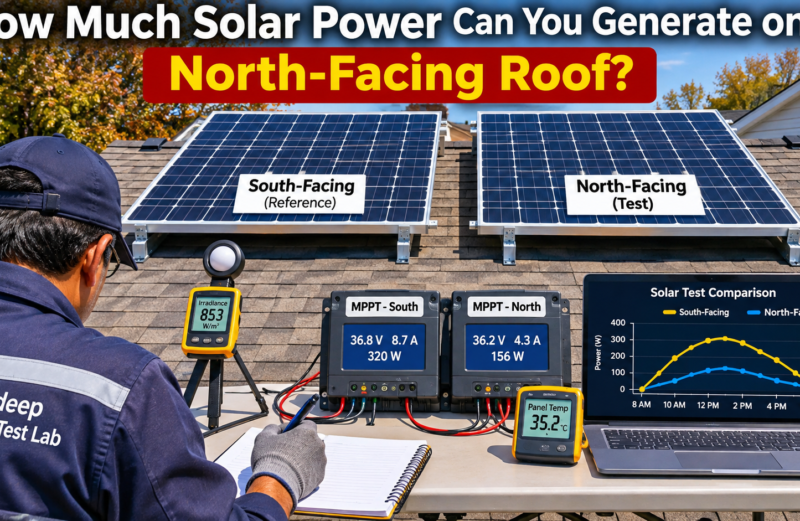
One of the first things I check before recommending a residential solar installation is the direction of the roof. Roof orientation has a direct influence on solar electricity generation, particularly in countries located in the Northern Hemisphere, such as the United States and Canada.
In these countries, south-facing solar panels generally receive more direct sunlight throughout the year. But what happens when a homeowner has a north-facing roof and limited installation space on other sides of the house? Should they completely avoid installing solar panels?
During my 25 years of experience in electrical engineering, solar installations, procurement, commissioning, and practical laboratory testing, I have learned that solar performance cannot be judged by one factor alone. Panel orientation, roof inclination, geographical location, shading, temperature, and seasonal sunlight all influence the final electricity generation.
For this experiment, I wanted to investigate a question that many homeowners ask: How much electricity can a north-facing roof actually generate compared with a south-facing roof?
We will examine two identical solar panels, compare their expected performance, understand the effect of roof angles, and calculate the potential electricity generation for residential properties in the USA and Canada.
The purpose is not to suggest that north-facing roofs are as productive as south-facing roofs. Instead, I want to understand how much energy homeowners can realistically expect and whether such an installation makes financial sense.
1. Understanding North-Facing Solar Panel Performance
Solar panels generate electricity when sunlight reaches their photovoltaic cells. The amount of electricity produced depends on the intensity of sunlight, the angle of incidence, panel temperature, and electrical characteristics.
In the Northern Hemisphere, the sun generally travels across the southern part of the sky. This is why south-facing solar installations are usually preferred.
A south-facing panel receives more direct sunlight during the middle of the day, particularly when its inclination is suitable for the geographical latitude.
A north-facing panel, on the other hand, is generally positioned away from the sun’s direct path.
However, this does not mean that north-facing panels cannot generate electricity.
There are three important sources of solar radiation:
-
Direct sunlight reaching the panel directly from the sun.
-
Diffuse sunlight scattered by clouds and atmospheric particles.
-
Reflected sunlight from surrounding surfaces.
Even when a north-facing panel receives limited direct sunlight, it can still generate electricity from diffuse solar radiation.
This is particularly relevant in locations where the roof has a shallow inclination and the surrounding environment provides good exposure to the sky.
2. Our Solar Panel Experiment: North-Facing vs South-Facing
To understand the difference between roof orientations, I would conduct a controlled comparison using two identical solar panels.
For this experiment, I have selected two 400W monocrystalline solar panels.
Both panels should have identical specifications, including rated power, operating voltage, current, dimensions, and cell technology.
The first panel will face south, while the second will face north.
Both panels will be installed at the same inclination angle and under similar environmental conditions.
The experimental equipment includes:
-
Two 400W monocrystalline solar panels.
-
Two independent MPPT charge controllers or equivalent monitoring channels.
-
Digital multimeters.
-
DC clamp meters.
-
Solar irradiance meter.
-
Panel temperature sensors.
-
Energy monitoring equipment.
-
Data logging system.
I would also ensure that neither panel is affected by additional shading from trees, chimneys, neighbouring buildings, or other roof structures.
An important point here is that both panels should operate independently. Connecting them together in the same series string could introduce electrical mismatch and affect the accuracy of the comparison.
During the experiment, I would record voltage, current, instantaneous power, daily energy production, panel temperature, and environmental conditions.
The most important parameter is daily energy generation measured in kilowatt-hours (kWh).
Solar panel voltage alone cannot tell us how much electricity a panel produces.
The electrical power is calculated using:
Power (W) = Voltage (V) × Current (A)
For example, if a solar panel operates at 36 volts and produces 8 amperes:
36 × 8 = 288 watts.
This means the panel is generating 288W at that particular moment.
To understand its actual energy production, we must record the power generated over time.
3. How Much Electricity Can a 400W North-Facing Solar Panel Generate?
Let’s perform a practical calculation.
Assume we install two identical 400W solar panels in the same geographical location.
For our illustrative comparison, assume the south-facing panel produces an average of 1.6 kWh per day, while the north-facing panel produces 0.8 kWh per day.
These are hypothetical values for explaining the calculation, not measurements from a completed field experiment.
The comparison would look like this:
South-facing panel:
400W panel × 4 equivalent full-sun hours = 1,600Wh.
Therefore, daily generation = 1.6 kWh.
North-facing panel:
400W panel × 2 equivalent full-sun hours = 800Wh.
Therefore, daily generation = 0.8 kWh.
Over 30 days:
South-facing panel = 1.6 × 30 = 48 kWh.
North-facing panel = 0.8 × 30 = 24 kWh.
Over one year, assuming these daily averages remain constant:
South-facing panel = 1.6 × 365 = 584 kWh.
North-facing panel = 0.8 × 365 = 292 kWh.
In this example, the north-facing panel generates approximately 50% of the electricity produced by the south-facing panel.
However, I would not apply this percentage to every residential property.
The actual difference can be smaller or considerably larger depending on roof pitch, latitude, weather, shading, and surrounding environmental conditions.
For an accurate estimate, homeowners should use location-specific solar irradiance data and a proper solar production model.
4. Testing North-Facing Solar Panels in Different US Locations
The United States has significant geographical and climatic variation. Solar production in Florida can be very different from production in Minnesota or Washington.
Therefore, we should not use one national generation estimate for every north-facing roof.
Florida
Florida receives substantial sunshine throughout the year.
A north-facing roof may still generate useful electricity through diffuse sunlight, particularly when the roof has a shallow inclination and good exposure to the sky.
However, a steep north-facing roof may experience significantly lower production.
For Florida homeowners, I would examine the roof angle, nearby buildings, tree shading, and annual solar irradiance before recommending an installation.
Texas
Texas is another interesting location because many residential properties have relatively large roof areas.
A house may have a north-facing main roof but still offer suitable east- or west-facing roof sections.
In such situations, I would compare the expected electricity generation from all available roof surfaces.
If the north-facing roof is the only available option, I would calculate its annual energy production and compare the financial return against the installation cost.
A solar installation should not be approved simply because there is sufficient physical roof space.
California
California has different solar conditions depending on the region.
Southern California generally receives more sunshine than several coastal and northern regions.
A north-facing roof in Los Angeles may perform differently from a similar roof in San Francisco because of differences in solar exposure, weather, and seasonal conditions.
For California homeowners, shading analysis is particularly important.
A roof that receives uninterrupted diffuse sunlight may still offer useful generation, but a heavily shaded north-facing roof can become economically unattractive.
5. What Happens When We Install Solar Panels on North-Facing Roofs in Canada?
Canada presents additional challenges because of its geographical latitude and seasonal sunlight variations.
During summer, days are longer, providing more available daylight hours. During winter, the sun remains lower in the sky and daylight hours become considerably shorter.
These conditions can affect north-facing solar installations more significantly.
Toronto, Ontario
Toronto receives reasonable solar resources for residential photovoltaic installations.
However, north-facing panels can experience reduced production, particularly during winter.
Snow accumulation can also cover the panel surface and temporarily reduce electricity generation.
For a Toronto homeowner, I would recommend evaluating the annual energy production rather than relying on summer performance alone.
Vancouver, British Columbia
Vancouver experiences considerable cloud cover and rainfall during parts of the year.
Solar panels can generate electricity under cloudy conditions, but their output generally decreases when available solar irradiance is reduced.
A north-facing installation may therefore face additional production limitations.
A shallow roof with good exposure to the sky may still be worth evaluating, but homeowners should carefully examine the expected annual generation.
Calgary, Alberta
Calgary receives substantial sunshine in several seasons and has attractive solar potential.
However, winter performance remains an important consideration.
Low solar elevation, shorter daylight hours, and snow accumulation can reduce electricity generation.
One interesting point about Calgary is that cold temperatures can actually improve photovoltaic module efficiency when sufficient sunlight reaches the panels.
Therefore, cold weather itself is not necessarily the problem. Reduced sunlight and snow coverage are often more important factors.
6. Does Roof Inclination Affect North-Facing Solar Generation?
During solar installation planning, I always consider roof inclination along with roof direction.
Imagine two houses with north-facing roofs.
The first house has a roof inclination of 15 degrees, while the second has a roof inclination of 40 degrees.
Although both roofs face north, the angle at which sunlight reaches their solar panels will be different.
A steep north-facing roof generally presents a less favourable angle because the panel surface is tilted away from the sun’s usual southern path.
A shallow north-facing roof may receive more favourable diffuse radiation and, depending on the season and location, some direct sunlight.
For a proper engineering assessment, I would compare roof inclinations of 10, 15, 25, 35, and 45 degrees.
However, there is no universal rule that a particular angle will always produce the best results.
The optimum angle depends on geographical latitude, seasonal sunlight, roof orientation, and the homeowner’s energy requirements.
I would also avoid changing the existing roof inclination without considering structural loading, wind resistance, mounting requirements, and local building regulations.
7. Can We Improve the Performance of North-Facing Solar Panels?
If a homeowner has no suitable south-facing roof, several practical measures can improve the performance of a north-facing installation.
Use High-Efficiency Solar Panels
Modern monocrystalline solar panels offer higher power output per square metre than many older technologies.
This is useful when available roof space is limited.
However, a high-efficiency panel does not eliminate the disadvantages of poor orientation. It simply allows more rated capacity to be installed within the available area.
Reduce Shading
Shading is one of the most important factors affecting solar production.
Trees, chimneys, neighbouring buildings, and rooftop structures can reduce the electricity generated by a solar panel.
Before installing a system, I would conduct a shading assessment at different times of the day and throughout the year.
Use Suitable MPPT Technology
Maximum Power Point Tracking helps a solar inverter or charge controller extract the available power from photovoltaic panels under changing operating conditions.
For installations with different roof orientations, separate MPPT inputs can help manage different electrical operating conditions.
Consider East- and West-Facing Roof Sections
If a property has north-, east-, and west-facing roof sections, it may be possible to use multiple orientations.
However, each roof section must be evaluated independently.
The inverter configuration should also be designed to handle the different generation characteristics without introducing unnecessary electrical mismatch.
Evaluate Alternative Mounting Arrangements
In some situations, a homeowner may consider mounting panels at a different angle rather than following the existing roof surface.
However, this requires proper structural assessment.
Additional mounting structures increase material costs and can introduce higher wind loads.
The extra electricity generated must justify the additional investment.
8. Is a North-Facing Solar Installation Financially Worthwhile?
Technical feasibility and financial feasibility are two different things.
A north-facing solar installation may generate electricity successfully, but that does not automatically mean it is a good investment.
Let’s consider a hypothetical 5 kW residential solar installation.
Assume the following annual generation:
South-facing system: 7,300 kWh.
North-facing system: 3,650 kWh.
Now assume the homeowner pays $0.18 per kWh for electricity.
The annual electricity value of the south-facing system would be:
7,300 × $0.18 = $1,314.
For the north-facing system:
3,650 × $0.18 = $657.
The difference is $657 annually.
These figures are illustrative and do not represent actual production forecasts for a particular American or Canadian property.
If both installations have approximately the same initial cost, the north-facing system would take considerably longer to recover its investment.
However, the financial calculation can change when the homeowner has no alternative roof surface.
I would also consider electricity export rates, net-metering policies, utility tariffs, available incentives, and the percentage of electricity consumed directly by the household.
A system that generates less electricity can still be useful if it reduces expensive grid electricity purchases during the hours when the home consumes power.
9. How I Would Conduct a Full-Year North-Facing Solar Test
A single afternoon of testing is not enough to establish the actual performance of a solar panel.
Solar irradiance changes throughout the day, and seasonal variations can significantly influence electricity generation.
If I were conducting this experiment in my electrical laboratory, I would follow a systematic testing procedure.
Step 1: Install Identical Solar Panels
Install two identical 400W panels, one facing north and the other facing south.
Maintain the same inclination angle and ensure that both receive comparable environmental exposure.
Step 2: Install Independent MPPT Controllers
Each panel should operate independently to prevent one panel’s electrical characteristics from affecting the other.
Step 3: Measure Electrical Parameters
Record DC voltage, current, instantaneous power, and cumulative energy production.
Step 4: Record Weather Conditions
Measure solar irradiance, panel temperature, cloud cover, and any shading conditions.
Step 5: Collect Daily Data
Record readings at regular intervals throughout the day.
I would pay particular attention to morning, midday, and afternoon performance.
Step 6: Continue Testing Across Different Seasons
Ideally, the experiment should continue for 12 months.
This will help identify differences between summer, winter, spring, and autumn.
Step 7: Compare the Final Results
Calculate total daily, monthly, and annual electricity production.
I would also calculate the percentage difference between the two panels.
This approach provides a much more reliable comparison than using a few instantaneous voltage or current readings.
10. Common Mistakes Homeowners Should Avoid
There are several mistakes I would advise homeowners to avoid before installing solar panels on a north-facing roof.
First, do not assume that a north-facing roof produces zero electricity. Panels can generate power from diffuse sunlight.
Second, do not use a generic solar calculator without entering the correct roof orientation and inclination.
Third, do not ignore seasonal performance. A system that performs reasonably well during summer may produce considerably less electricity during winter.
Fourth, do not connect panels with significantly different orientations into an unsuitable electrical configuration. The inverter and MPPT arrangement must be designed correctly.
Fifth, do not compare solar panels using voltage alone. Daily energy generation in kWh is a much more useful performance indicator.
Finally, do not ignore installation economics. A technically functional system can still be a poor investment if its electricity generation is too low compared with its installation cost.
Conclusion
So, how much solar power can you generate on a north-facing roof?
The answer depends on geographical location, roof inclination, shading, seasonal sunlight, and the solar equipment being used.
In the United States, north-facing roofs can still generate useful electricity, particularly when they have a shallow inclination and good exposure to the sky. However, south-facing installations generally offer better annual production.
In Canada, seasonal variations make the calculation more complicated. Shorter winter days, low solar elevation, cloud cover, and snow accumulation can significantly affect north-facing solar installations.
My recommendation is to avoid rejecting a roof simply because it faces north. Start with a proper engineering assessment. Check the available roof area, measure the inclination, evaluate surrounding obstructions, and calculate the expected annual electricity production.
If you have both north- and south-facing roof sections, compare their expected lifetime electricity generation before deciding where to install the panels.
I would also encourage homeowners to request separate generation estimates for each roof orientation rather than accepting one combined figure from an installer.
After 25 years of working with electrical systems, solar installations, and practical testing, one thing has become clear to me: a solar panel’s rated wattage is only one part of the equation. Its actual performance depends on the conditions in which it operates.
A north-facing roof is not automatically useless for solar power. However, homeowners must understand the limitations before investing their money.
The best solar installation is not necessarily the one with the maximum number of panels. It is the one that produces reliable electricity at a reasonable lifetime cost.
Disclaimer: The generation figures and financial calculations in this article are illustrative engineering examples, not verified field-test results. Actual solar production depends on geographical location, roof orientation, inclination, shading, weather, equipment specifications, and installation quality. Consult a qualified solar professional and follow applicable local electrical and building regulations before installing a residential solar system.