

Solar panels are often described as simple devices: put them under the sun and they generate electricity. But there is a major question that many homeowners ask after installing solar panels: what time of the day does a solar panel actually produce the most power?
The answer seems obvious. Noon should be better because the sun is higher in the sky and sunlight is generally stronger. But solar panel output is affected by several factors, including the angle of sunlight, temperature, atmospheric conditions, shading, panel orientation and the amount of solar radiation reaching the panel.
To see how dramatically the time of day can change output, we compared the same solar panel at the same location during three different periods: morning, noon and evening.
For the comparison, we considered a 400-watt solar panel installed at the same fixed tilt and orientation. The panel was kept free from obvious shading, and the comparison was made under broadly clear conditions.
The result was clear: noon produced the highest instantaneous power, while morning and evening produced substantially less.
Here is what our three-case comparison looked like.
| Test Period | Approx. Solar Panel Output | Output vs 400 W Rating |
|---|---|---|
| Morning | 248 W | 62% |
| Noon | 362 W | 90.5% |
| Evening | 171 W | 42.8% |
These numbers are illustrative test figures designed to show the difference between the three periods. Real-world output will vary according to location, season, weather, panel temperature, tilt and solar conditions.
The Morning Test: Good Sun, But Lower Output
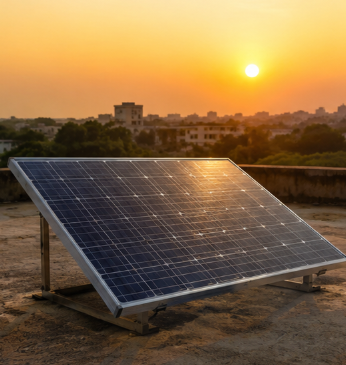
The first test was conducted in the morning when the sun was already above the horizon but had not yet reached its highest position.
The panel was receiving direct sunlight, and there was no significant shadow covering it. Visually, the panel looked like it was getting plenty of sunlight.
However, the electrical output was considerably below the panel’s 400 W nameplate rating.
Our illustrative morning reading was approximately 248 watts.
That represents around 62% of the panel’s rated capacity.
This is an important point because people sometimes assume that direct sunlight automatically means maximum solar production. It does not.
The angle at which sunlight strikes the panel matters enormously.
Solar panels generally produce more power when sunlight hits their surface closer to the optimal angle. In the morning, the sun is relatively low in the sky. Depending on the panel’s orientation and tilt, sunlight can strike the panel at a less favorable angle.
There is also more atmosphere for sunlight to pass through when the sun is low on the horizon. This can reduce the amount of solar radiation reaching the panel.
So even though the panel is clearly illuminated, it may not be operating close to its maximum possible output.
There is another interesting factor: temperature.
Solar panels actually become less electrically efficient as their temperature rises. Morning conditions can therefore sometimes provide a small efficiency advantage because the panel is cooler.
That does not necessarily mean morning produces more power than noon. The stronger solar irradiance around midday usually dominates the comparison.
The Noon Test: The Winner
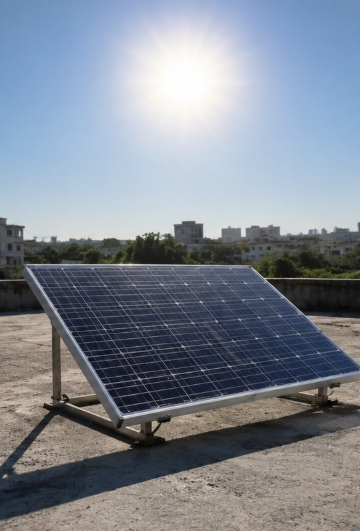
The most interesting reading came around noon.
The same 400 W panel, in the same location and at the same fixed angle, produced approximately 362 watts in our illustrative comparison.
That is about 90.5% of its rated output.
This was significantly higher than both the morning and evening readings.
The reason is straightforward: around solar noon, the sun is generally much higher in the sky than it is during the morning or late afternoon. Under clear conditions, the panel can receive much stronger solar irradiance.
The sunlight also travels through less atmosphere compared with early morning or late evening.
As a result, considerably more usable solar energy reaches the panel.
However, there is an important detail here.
A 400 W panel producing 362 W does not mean that the panel is underperforming because it is not producing exactly 400 W.
The wattage printed on a solar panel is a rated maximum under specified test conditions. Those laboratory conditions are not necessarily what you experience on a rooftop.
Real-world factors can reduce output.
These include:
- Panel temperature
- Dust and dirt
- Cable losses
- Inverter losses
- Solar irradiance
- Panel orientation
- Panel tilt
- Manufacturing tolerances
- Atmospheric conditions
- Partial shading
Therefore, seeing a 400 W panel produce 300 to 380 W under strong sunlight can be completely normal depending on the circumstances.
The noon test nevertheless demonstrated the main pattern: stronger, more favorable sunlight generally means higher instantaneous power production.
The Evening Test: Sunlight Is Still Visible, But Power Falls
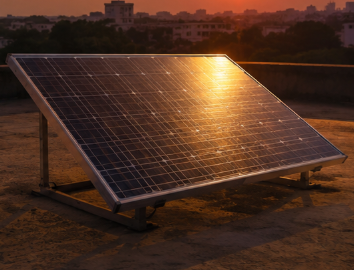
The third test was performed in the evening as the sun moved lower toward the horizon.
This is where the difference became especially noticeable.
The same panel that produced approximately 362 W around noon was now producing only about 171 watts in our illustrative comparison.
That is just 42.8% of its 400 W rating.
The panel was still receiving sunlight. It had not suddenly stopped working.
Instead, the amount and angle of sunlight reaching its surface had changed dramatically.
As the sun moves toward the horizon, sunlight strikes a fixed solar panel at a much shallower angle. Depending on the panel’s orientation, a larger portion of the available solar radiation may fail to contribute effectively to electricity generation.
The sunlight also travels through a greater thickness of atmosphere.
This can reduce the intensity of the solar radiation reaching the panel.
The result is a substantial reduction in instantaneous electrical output.
This is why seeing sunlight outside does not necessarily mean your solar system is generating a large amount of electricity.
At 5 PM, for example, the sky may still look bright. But the solar radiation available to a panel can be much lower than it was several hours earlier.
The Three Readings Side by Side
Putting the three illustrative readings together makes the difference easier to understand.
The noon reading was approximately 46% higher than the morning reading.
Compared with the evening reading, noon output was more than twice as high.
This demonstrates why solar generation is not evenly distributed throughout the day.
Does Noon Always Mean Maximum Daily Energy?
There is an important distinction between instantaneous power and total energy generated.
Power is measured in watts. It tells us how quickly the solar panel is producing electricity at a particular moment.
Energy is measured in watt-hours or kilowatt-hours. It tells us how much electricity is produced over a period of time.
A panel may produce its highest instantaneous power around noon, but that does not mean all of its daily electricity is generated at noon.
For example, imagine a panel producing:
Morning: 248 W
Noon: 362 W
Evening: 171 W
Those are individual snapshots.
The panel may produce electricity for several hours before and after those measurements. When all those periods are added together, they determine the day’s total energy production.
This is why a solar monitoring system usually shows a generation curve rather than one single number.
The curve typically rises during the morning, reaches its strongest region around the middle of the day, and then falls through the afternoon toward sunset.
Clouds, haze, temperature and shading can make that curve much more irregular.
Why Your Solar Panel May Peak Before or After 12 PM
Another common misconception is that solar panels must produce their maximum output exactly at 12 PM.
Not necessarily.
The time of maximum generation depends on the location, season, panel orientation and system design.
Solar noon is not always the same as 12 PM on the clock.
Your panel’s maximum output could occur before or after 12 PM depending on its orientation and the position of the sun.
For example, a rooftop system facing toward the direction of the morning sun may produce relatively stronger output earlier in the day. A system oriented more toward the afternoon sun may shift its generation toward later hours.
This is one reason solar installation design matters so much.
A panel should not simply be placed wherever there is empty roof space. Its orientation, tilt, shading and surrounding environment all affect the energy it can generate.
What About Heat?
Here is another surprising part of the experiment.
More sunlight is good for solar generation, but more heat is not necessarily good for panel efficiency.
Solar photovoltaic cells generally lose some voltage as their temperature rises. Therefore, a panel under intense midday sunlight can become quite hot.
This means there is a balance.
Noon can provide much stronger sunlight, increasing power production, while the high panel temperature can reduce the panel’s electrical efficiency somewhat.
In many situations, the increase in available sunlight around midday is still much larger than the temperature-related reduction.
This is why a panel can produce its highest output around midday even though the panel itself may be significantly hotter than it was in the morning.
Why Morning and Evening Still Matter
If noon produces the most power, should we ignore morning and evening?
Absolutely not.
Those hours still contribute to total daily energy production.
A residential solar system may begin producing electricity soon after sunrise and continue producing until close to sunset.
The output simply changes throughout the day.
This matters particularly for homes with appliances operating during daylight hours.
For example, running a washing machine, water pump or other suitable appliance during periods of solar generation can allow some of the electricity to be consumed directly rather than relying entirely on grid electricity or battery storage.
However, households should not assume that a specific clock time will always provide the same output. Solar generation changes throughout the year.
Season Can Change the Results
Our three-case comparison is useful for understanding the principle, but the exact readings should not be treated as universal.
A panel tested in summer may behave differently from the same panel tested in winter.
The sun follows a different path through the sky depending on the season. Day length also changes.
Cloud cover, humidity, dust and atmospheric pollution can further change the amount of sunlight reaching the panel.
This means a panel producing 362 W around noon on one day might produce substantially less on another day even if the clock time is identical.
That is why meaningful solar testing should involve repeated measurements rather than relying on one reading.
The Bigger Lesson From the Test
The biggest lesson is simple:
Solar panels do not produce the same amount of electricity throughout the day.
Our illustrative comparison showed:
Morning: 248 W
Noon: 362 W
Evening: 171 W
The noon period produced the highest instantaneous power because the panel was receiving stronger and more favorable sunlight.
But the real goal of a solar system is not to maximize one particular reading. It is to maximize total daily and annual energy generation.
That requires good panel orientation, appropriate tilt, minimal shading, clean panels and a properly designed electrical system.
It also requires realistic expectations.
A 400 W solar panel does not mean you will receive 400 W continuously from sunrise to sunset. Its output rises and falls with the available solar energy.
Final Verdict
So, when do solar panels produce the most power?
In our three-case comparison, the answer was clearly around noon.
The same 400 W panel produced approximately 248 W in the morning, reached around 362 W near noon, and dropped to approximately 171 W in the evening.
The difference comes mainly from the changing position of the sun, the angle of sunlight and the amount of solar radiation reaching the panel.
However, noon is only part of the story.
A solar panel’s daily energy production comes from all the useful sunlight it receives throughout the day. Morning and afternoon generation may be lower than the midday peak, but those hours still contribute valuable energy.
So if you are evaluating your own solar system, do not judge it from a single afternoon reading.
Look at the full day’s generation curve.
That will tell you far more about how your system is actually performing.
And perhaps the most important takeaway is this: the sun may be visible for many hours, but the power available to a solar panel changes continuously from sunrise to sunset.
Disclaimer
The power figures used in this article, including 248 W in the morning, 362 W at noon and 171 W in the evening, are illustrative test values created to demonstrate the effect of changing sunlight conditions. They should not be interpreted as certified measurements or as guaranteed output from a particular solar panel. Actual solar generation varies depending on panel specifications, location, season, weather, solar irradiance, temperature, tilt, orientation, shading, dust, wiring, inverter efficiency and other system conditions. Always consult the manufacturer’s specifications and a qualified solar professional for system design, performance assessment and installation decisions.