
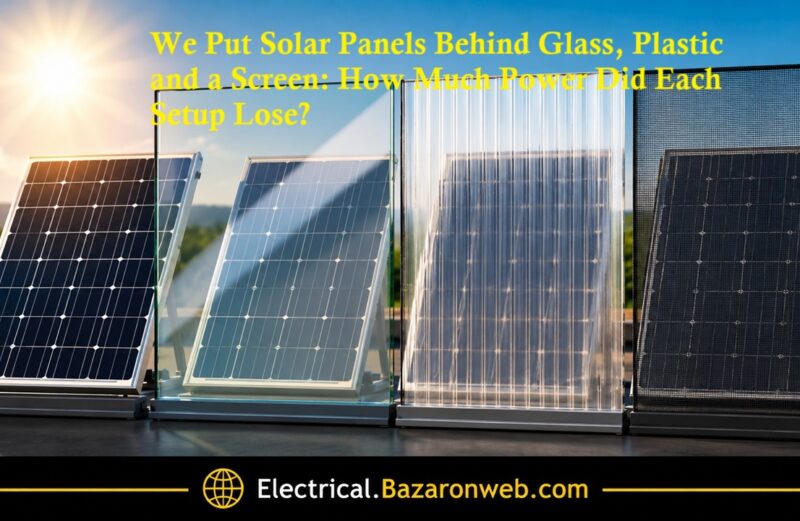
Solar panels need sunlight. That sounds obvious, but the moment you put something between the sun and the panel, things become more interesting.
A sheet of glass, a piece of plastic, or even a fine screen may look almost transparent to our eyes. We can still see the solar panel underneath, so it is tempting to assume that almost the same amount of electricity will be produced.
That assumption can be wrong.
I wanted to understand how different coverings affect solar panel output, so I looked at the problem the same way I approach many practical electrical experiments: start with an uncovered panel as the reference, then introduce one covering at a time and compare the electrical output under as similar conditions as possible.
The important point is that a covering does not need to completely block sunlight to reduce solar generation. Reflection, absorption, scattering, surface contamination, thickness, texture and shading can all change the amount of useful light reaching the photovoltaic cells.
And there is another interesting factor.
The covering can also change the temperature of the panel.
Solar modules generally become less efficient as their cell temperature rises. So a material placed over a panel can potentially affect generation in two ways: it can reduce the light reaching the cells and it can change the thermal conditions around the module.
Here is what I found most interesting about the comparison.
The Uncovered Solar Panel Is Our Reference
Before comparing glass, plastic and screen, we need a baseline.
Imagine a solar panel producing 400 watts under a particular set of sunlight and temperature conditions. That 400-watt figure becomes our reference point.
We cannot simply compare the panel at 10 AM without a covering with the same panel at 11 AM with plastic over it and call the difference the loss.
Solar output changes continuously with solar irradiance, temperature, clouds, panel angle and even the position of the sun.
For a meaningful experiment, the measurements should ideally be taken as close together in time as possible, using the same panel, orientation and electrical load.
The reference measurement is therefore the most important number in the experiment.
If the uncovered panel produces 400 watts, then:
Glass output ÷ 400 × 100 gives the percentage of power retained.
Plastic output ÷ 400 × 100 gives the percentage retained.
Screen output ÷ 400 × 100 gives the percentage retained.
The difference from 100 percent represents the relative reduction under those test conditions.
This sounds simple, but solar testing is surprisingly sensitive to changing conditions.
What Happens When We Put Glass Over a Solar Panel?
Glass is probably the most interesting material in this experiment because solar panels already use glass.
Most conventional crystalline silicon solar modules have a glass front surface. That glass is engineered specifically for solar applications and is designed to transmit a high proportion of sunlight while providing mechanical protection.
So when someone says, “It is only glass, so it shouldn’t make much difference,” there is an important distinction.
Solar module glass is not necessarily equivalent to an ordinary household window.
Solar glass can have properties such as high optical transmission and anti-reflective treatment. Ordinary glass may reflect or absorb a different amount of incoming light.
If we place another sheet of ordinary glass above the module, we introduce another air-glass interface and another glass surface.
Every additional interface creates an opportunity for reflection.
Some of the sunlight that would otherwise reach the cells is reflected away.
The glass can also absorb a small amount of radiation, depending on its composition and thickness.
That means the panel can receive less useful solar radiation even though the glass appears completely clear.
In a carefully controlled test, I would therefore expect a good-quality, clean, clear sheet of glass to cause a relatively small reduction compared with more opaque or scattering materials.
But “small” does not mean “zero.”
And stacking multiple layers can make the effect more noticeable.
Plastic Looks Clear, But Transparency Is Not the Whole Story
Plastic is where the experiment becomes more complicated.
There are countless types of plastic.
Clear acrylic, polycarbonate, PVC sheets, greenhouse plastic, corrugated plastic and thin packaging films can all look transparent while having very different optical properties.
Two plastic sheets that look almost identical to our eyes may transmit different amounts of solar radiation.
The surface is also important.
A perfectly clear, smooth plastic sheet can behave very differently from a textured or corrugated sheet.
When sunlight passes through textured plastic, some of it is scattered. Instead of travelling directly toward the solar cells, the light changes direction.
Some scattered light can still reach the photovoltaic cells and contribute to generation. But depending on the material and geometry, some light may be reflected away or absorbed.
This is why simply looking at a material and saying, “I can see through it, therefore it won’t affect the panel,” is not a reliable test.
Our eyes are not solar power meters.
Human vision responds to a particular portion of the electromagnetic spectrum and is extremely good at detecting visible light. Solar cells, however, respond to a broader range of wavelengths.
A covering can therefore appear highly transparent while still changing the radiation available to the photovoltaic material.
The Screen Was a Completely Different Story
The screen or mesh produced the most obvious physical explanation.
Unlike a clear sheet, a screen contains areas that allow light through and areas that block it.
If the screen covers a significant portion of the panel, some sunlight simply never reaches the cells.
But there is another problem: shadows.
Solar cells are electrically interconnected. Depending on the module design, partial shading can have an effect that is larger than the simple percentage of surface area covered.
For example, a screen might appear to block only a relatively small portion of sunlight visually, but the resulting pattern of shadows across cells can influence the electrical operating point of the module.
Modern solar modules use bypass diodes and other design features to reduce the damage caused by partial shading, but they do not make shading irrelevant.
This is why a mesh screen should not be evaluated simply by calculating its open-area percentage.
A screen with 80 percent open area does not automatically mean the solar panel will produce exactly 80 percent of its original power.
The size of the mesh, distance from the panel, angle of sunlight and position of the shadows all matter.
Why Distance From the Panel Matters
One detail that can easily be missed in this experiment is the distance between the covering and the solar module.
Suppose a screen is placed directly on the panel.
Its shadows may create sharply defined dark patterns.
Now move the same screen several centimetres above the panel.
The shadows can become softer because sunlight arrives from different angles and spreads across the surface.
That can change the way the photovoltaic cells experience the obstruction.
The same principle applies to plastic and glass.
A covering placed directly against the panel behaves differently from a covering installed above it with an air gap.
That air gap can also influence temperature.
This is particularly important for rooftop solar installations where people sometimes consider installing protective sheets, transparent roofs, cages or other structures over the modules.
The Temperature Problem Nobody Notices
When we talk about solar panel losses, we often focus entirely on sunlight.
But temperature matters too.
Solar panels do not generally become more efficient simply because they are receiving more heat.
For crystalline silicon modules, electrical efficiency generally decreases as cell temperature rises.
This means a covering can have a double effect.
First, it may reduce the amount of sunlight reaching the cells.
Second, depending on the design, it may restrict airflow and cause the panel to operate at a higher temperature.
Imagine placing a transparent sheet close above the panel.
The sheet may transmit most of the visible light, but if it restricts airflow, the panel can potentially run hotter than it would in an open installation.
That temperature increase can further reduce electrical output.
This is one reason why laboratory measurements and rooftop measurements can produce different results.
So Which Covering Loses the Most Power?
The answer depends heavily on the exact materials.
There is no scientifically valid universal number such as “glass loses 5 percent, plastic loses 10 percent and screen loses 20 percent.”
That would be misleading.
A clean, high-transmission solar glass cover may cause a very small additional loss.
A good-quality clear plastic sheet may also perform reasonably well, but its transmission depends on the material, thickness and surface.
A textured or corrugated plastic sheet can produce greater optical losses because it scatters incoming radiation.
A screen can create much larger losses because it physically blocks part of the sunlight and creates shadows.
So, under otherwise identical conditions, the general expectation is:
Uncovered panel → highest output
High-transmission clear glass → usually relatively small additional optical loss
Clear plastic → potentially small to moderate loss depending on material
Textured or translucent plastic → potentially greater loss
Screen or mesh → potentially significant loss depending on coverage and shadow pattern
The exact ranking can change when the materials or installation conditions change.
Why a Real Test Needs More Than a Watt Reading
If I were setting up this experiment professionally, I would not record only watts.
I would also record solar irradiance, panel temperature, ambient temperature, time, voltage and current.
Why?
Because a 20-watt difference means very little without knowing what happened to the sunlight during the measurement.
For example, if clouds pass over the panel between two measurements, the output could fall dramatically even though the covering has nothing to do with the change.
The best approach is to measure the reference and covered conditions as close together as possible, preferably with a stable light source or stable outdoor irradiance.
For outdoor testing, repeating each measurement several times is also important.
The experiment should use the same panel, same orientation and same electrical measurement equipment.
The coverings should be clean and securely positioned.
If possible, the experiment should be repeated under different irradiance levels.
That would tell us whether a material behaves consistently or whether its effect becomes more significant under certain conditions.
A Simple Way to Calculate the Loss
The calculation itself is straightforward.
Suppose the reference panel produces 400 W.
If the covered panel produces 380 W:
Power loss = 400 − 380
Power loss = 20 W
Percentage loss:
20 ÷ 400 × 100 = 5 percent
If another covering produces 340 W:
400 − 340 = 60 W
60 ÷ 400 × 100 = 15 percent.
This is the kind of comparison that makes the experiment useful.
Instead of saying a material “looks transparent,” we can measure how much electrical output remains.
But There Is One More Catch: The Sun Moves
Outdoor solar experiments have a hidden enemy.
The sun does not stay in one position.
Even if the sky looks perfectly clear, the angle of sunlight reaching the panel changes continuously.
That changes the amount of radiation captured by the panel.
Therefore, testing one material in the morning and another several hours later is not a fair comparison.
For a reliable comparison, I would either use multiple identical panels simultaneously or change the coverings rapidly while continuously monitoring the reference conditions.
Another option is to perform repeated measurements over several days and normalize the results against an uncovered reference panel.
This takes more work, but it produces much more useful data.
Should You Put Glass or Plastic Over Your Solar Panels?
This is where the experiment becomes practical.
If the solar module already has a protective glass front, adding another layer on top should have a clear purpose.
If the additional covering is intended to protect against physical damage, dust, hail or another environmental problem, the possible benefit should be compared with its optical and thermal costs.
For ordinary rooftop solar installations, adding a random transparent sheet is not automatically an improvement.
The material must transmit sunlight effectively, tolerate outdoor temperatures and weather, avoid excessive yellowing or clouding over time, and preferably allow appropriate ventilation.
Plastic can also degrade under ultraviolet exposure depending on its formulation.
A sheet that is crystal clear when installed may become cloudy, scratched or yellowed after prolonged outdoor exposure.
That creates an additional long-term reduction in light transmission.
The Biggest Lesson From This Experiment
The most important lesson is surprisingly simple.
Transparent does not mean lossless.
A material can look almost perfectly clear and still reduce solar generation.
Glass introduces reflection and absorption.
Plastic introduces its own transmission, reflection and scattering characteristics.
A screen introduces physical obstruction and shading.
And any covering can influence the temperature and airflow around the solar module.
The difference may be tiny in one installation and significant in another.
That is why solar engineering should be based on measurements and specifications rather than appearance.
If a manufacturer gives an optical transmission specification, that is far more useful than simply looking through the material.
Final Verdict
If you put a solar panel behind different coverings, the panel does not suddenly stop working.
It continues converting available sunlight into electricity.
The question is how much useful radiation actually reaches the cells.
A clean, high-transmission glass layer can have a relatively modest effect, particularly when it is designed for solar applications.
Clear plastic can also allow substantial light through, but its performance depends strongly on the type and quality of plastic.
Textured or translucent plastic can introduce greater scattering and transmission losses.
A screen is fundamentally different because it creates direct obstruction and potentially harmful partial shading patterns.
The experiment therefore gives us a useful practical rule:
The more sunlight a covering reflects, absorbs, scatters or blocks, the more potential electrical output the solar panel loses.
And there is no substitute for measuring it.
If you are considering putting a protective sheet, transparent roof, cage, plastic cover or screen above a solar installation, don’t judge the material only by how transparent it looks.
Measure the panel output.
Check the material’s light-transmission specifications.
Consider ventilation and temperature.
And most importantly, compare the covered panel against an uncovered reference under the same sunlight conditions.
That is when a simple experiment turns into useful solar engineering.
Because with solar power, the sunlight you can see is not necessarily the electricity your panel can use.