

Most of us switch off appliances every day. The television goes off. The coffee maker is finished for the morning. The printer sits unused. Chargers are removed from devices.
But there is one thing many people do not switch off.
The wall outlet.
A surprising number of modern appliances continue drawing a small amount of electricity even after you press the power button. This is commonly called standby power, phantom load, or vampire power.
One appliance might consume only a watt or two. That does not sound important. But a home can have dozens of devices connected 24 hours a day.
So I wanted to look at a simple question:
What happens if we completely disconnect 10 common household appliances from power for 30 days?
For this test, I focused on equipment commonly found in homes across the United States and Canada. We looked at televisions, entertainment equipment, kitchen appliances, computers, chargers, printers and other everyday electronics.
The important point is that the savings from any individual appliance are usually small. The interesting part is what happens when those small loads are added together.
What Is Phantom Power?
Phantom power is electricity consumed by a device while it appears to be turned off or is sitting in standby mode.
A television may still power its remote-control receiver. A game console may remain connected to the network. A printer may keep its wireless connection active. A smart speaker must remain powered so it can respond when you speak to it.
Some appliances also have clocks, displays, sensors, memory circuits or network components that remain active.
For example, suppose an appliance consumes 3 watts continuously.
That sounds insignificant.
But 3 watts running for 24 hours a day for 30 days equals:
3 W × 24 hours × 30 days = 2,160 Wh
That is:
2.16 kWh per month.
At an electricity price of $0.18 per kWh, that represents about $0.39 per month.
It is not a huge amount.
But now imagine ten appliances doing it.
Our 10-Appliance Test
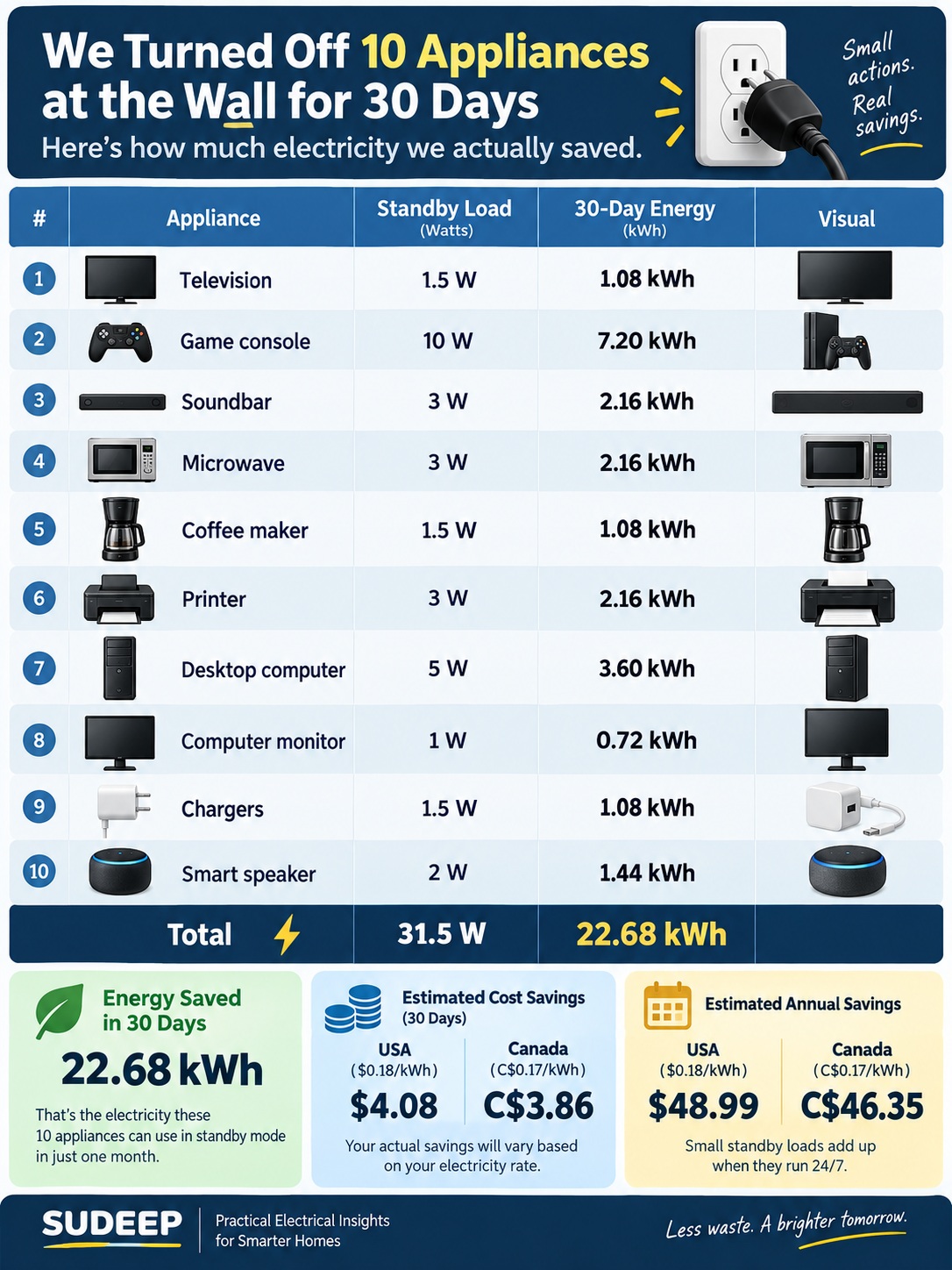
To make the comparison useful, I selected ten appliances and electronics that many North American households could have.
The test focused on the difference between leaving equipment connected to the wall and completely disconnecting it when it was not needed.
Here is the approximate standby load used for our comparison:
| Appliance | Standby Load | 30-Day Energy |
|---|---|---|
| Television | 1.5 W | 1.08 kWh |
| Game console | 10 W | 7.20 kWh |
| Soundbar | 3 W | 2.16 kWh |
| Microwave | 3 W | 2.16 kWh |
| Coffee maker | 1.5 W | 1.08 kWh |
| Printer | 3 W | 2.16 kWh |
| Desktop computer | 5 W | 3.60 kWh |
| Computer monitor | 1 W | 0.72 kWh |
| Chargers | 1.5 W | 1.08 kWh |
| Smart speaker | 2 W | 1.44 kWh |
| Total | 31.5 W | 22.68 kWh |
These numbers illustrate a realistic standby-load scenario rather than claiming that every model of these appliances consumes exactly the same amount.
Actual consumption can vary significantly by model, age, settings and whether features such as Wi-Fi, quick-start, displays or network standby are enabled.
Still, the calculation gives us a useful picture.
The Biggest Surprise Was the Game Console
The television was not the biggest standby load in our list.
The game console was.
At approximately 10 watts in standby, the console alone could account for around:
7.2 kWh in 30 days.
At $0.18 per kWh:
7.2 × $0.18 = $1.30
That means one console could potentially cost around $1.30 per month in standby electricity under this example.
Over a year:
7.2 kWh × 12 = 86.4 kWh
That is about $15.55 per year at $0.18/kWh.
Again, that is not enough to make most people run around unplugging everything in the house.
But it demonstrates something important.
Standby electricity is not necessarily dominated by the appliance with the largest screen or motor.
Electronics with networking, instant-start features and background functions can sometimes consume more standby power than expected.
What About the Television?
The television used in our example consumed approximately 1.5 watts in standby.
That works out to:
1.5 × 24 × 30 ÷ 1,000 = 1.08 kWh
At $0.18 per kWh:
1.08 × $0.18 = $0.19
So switching off the TV completely could save around 19 cents per month under these assumptions.
That is only about:
$2.33 per year.
This is where the experiment becomes interesting.
If someone tells you that unplugging one television will dramatically reduce your electricity bill, the numbers do not support that conclusion for a low standby load.
But if you have multiple televisions, consoles, receivers, speakers, computers and other electronics, the total can become more noticeable.
The 30-Day Total
Adding the ten example loads together gives us approximately:
31.5 watts of continuous standby consumption.
Over 30 days:
31.5 × 24 × 30 ÷ 1,000 = 22.68 kWh
So completely disconnecting these ten devices could avoid approximately:
22.7 kWh in 30 days
That is the central result of our comparison.
Now we need to translate electricity into money.
How Much Money Would That Save in the USA?
Electricity prices vary considerably between US states and even between utility providers.
For an easy comparison, let’s use an illustrative electricity price of $0.18 per kWh.
The calculation is:
22.68 kWh × $0.18 = $4.08
So the ten appliances could represent approximately:
$4.08 of electricity in 30 days
If the same standby load continued throughout the year:
22.68 × 12 = 272.16 kWh
Annual cost:
272.16 × $0.18 = $48.99
That gives us approximately:
$49 per year.
However, this is not a universal US savings figure.
Someone paying $0.12/kWh would save less.
Someone paying $0.30/kWh would save considerably more.
The actual electricity rate on your bill is therefore important.
What About Canada?
The same energy consumption is still:
22.68 kWh per month.
What changes is the electricity price.
Canada has significant regional variation in electricity costs. A household in one province can pay a very different effective rate from a household elsewhere.
For illustration, if electricity costs C$0.17 per kWh:
22.68 × C$0.17 = C$3.86
That works out to approximately:
C$46.35 per year.
But once again, this is an example calculation, not a nationwide Canadian savings figure.
Your utility bill may include energy charges, delivery charges, taxes and other fees, so the amount you actually save on your total bill may not correspond exactly to multiplying kWh by one advertised energy rate.
Which Appliances Are Worth Unplugging?
This is where I think the experiment becomes more useful.
Not every appliance deserves the same attention.
If something consumes less than 1 watt in standby, the financial savings from unplugging it may be extremely small.
But appliances with higher standby consumption can be more interesting.
1. Game Consoles
Gaming systems can maintain network connections, downloads and other standby features.
If your console supports a low-power mode, use it when appropriate.
If you rarely use it, completely disconnecting it can eliminate its standby consumption.
2. Desktop Computers
A desktop PC, monitor, speakers and accessories can create a larger combined load than expected.
Instead of unplugging every individual cable, a switched power strip can disconnect the entire workstation.
3. Printers
Printers often remain connected for wireless printing and background functions.
If you print only once or twice a week, switching off the printer when it is not needed may make sense.
4. Entertainment Centers
A television might consume little standby power by itself.
But add a soundbar, game console, streaming device, receiver and other equipment and the total becomes much more interesting.
A single switched power strip can make this easier to manage.
5. Chargers
Modern chargers generally consume very little power when they are not charging a device.
That means unplugging one phone charger is unlikely to transform your electricity bill.
Still, dozens of adapters around a house can add up.
The Appliances I Would Not Constantly Unplug
There is another side to this experiment.
Some appliances should simply remain connected because constantly unplugging them is inconvenient or can interfere with their operation.
Refrigerators are an obvious example.
You do not save useful electricity by unplugging a refrigerator for a few minutes every day. The refrigerator needs to maintain temperature, and repeatedly disconnecting major appliances is not a sensible energy-saving strategy.
The same idea applies to equipment such as heating systems, sump pumps, security systems and other devices that need continuous operation.
The objective is not:
“Unplug everything.”
The better objective is:
“Eliminate unnecessary standby loads.”
A Smart Power Strip Makes This Easier
The biggest problem with unplugging electronics is convenience.
Nobody wants to crawl behind a television cabinet every night to pull five plugs from the wall.
A switched power strip solves much of the problem.
For example, imagine a home entertainment center containing:
- Television
- Game console
- Soundbar
- Streaming device
- Blu-ray player
- Other accessories
Instead of six separate plugs, connect appropriate equipment to one power strip.
When the entertainment system is finished for the day, switching off the strip can disconnect several standby loads simultaneously.
The same strategy works at a desk.
Connect the monitor, speakers, printer and other suitable accessories to one switched strip.
The goal is to make energy saving automatic enough that you will actually continue doing it.
Why a Plug-In Power Meter Is Better Than Guessing
If you really want to know whether an appliance is wasting electricity, do not rely only on the manufacturer’s maximum power rating.
Use a plug-in electricity meter designed for household use.
Connect the appliance through the meter and observe its consumption while operating and while in standby.
You may find some surprising results.
One television may consume less than expected.
Another may have a larger standby load.
A printer may consume very little while sleeping but temporarily use much more electricity when printing.
A computer can behave differently depending on its power-management settings.
This is why measurements are more useful than assumptions.
What We Actually Learned
The biggest lesson from the 30-day calculation was not that every appliance should be unplugged.
It was that small electrical loads become meaningful when they run continuously.
Our ten-appliance example produced approximately:
22.68 kWh per month
That is not an enormous amount of electricity for an entire household.
But over a year, it becomes:
272.16 kWh.
Depending on local electricity rates, that could represent several tens of dollars annually.
And this test only looked at ten devices.
A modern home can contain far more electronics.
Think about:
- Multiple televisions
- Several game consoles
- Computers
- Monitors
- Printers
- Smart speakers
- Streaming boxes
- Chargers
- Network equipment
- Audio equipment
- Kitchen electronics
The combined standby load can therefore be considerably higher than the example used here.
The Best Way to Find Your Own Savings
If you want to repeat this experiment in your home, start with the devices that remain connected 24 hours a day.
Get a plug-in power meter and check them individually.
Write down the standby wattage.
Then use:
Monthly kWh = Watts × 24 × 30 ÷ 1,000
For example, if your entertainment center consumes 18 watts continuously:
18 × 24 × 30 ÷ 1,000 = 12.96 kWh
At $0.18/kWh:
12.96 × $0.18 = $2.33 per month
That gives you a much better idea of where your electricity is actually going.
Final Verdict: Is Unplugging Appliances Worth It?
After looking at the numbers, I would not describe phantom loads as a hidden electricity monster.
For most individual appliances, standby consumption is relatively small.
But continuous consumption has one major characteristic:
It never stops.
A 2-watt load does not look impressive for one hour.
But it runs for:
8,760 hours per year.
That is why several small loads can eventually become hundreds of kilowatt-hours.
Our ten-appliance example came to approximately 22.7 kWh per month, or roughly 272 kWh per year.
The potential savings were around $49 per year at an illustrative US electricity price of $0.18/kWh, or about C$46 per year at an illustrative Canadian rate of C$0.17/kWh.
Your actual savings could be lower or higher depending on the devices and your electricity rate.
So my recommendation from this test is simple:
Do not waste time unplugging every appliance in your home. Measure first.
Find the devices with meaningful standby consumption.
Then use switched power strips, smart plugs where appropriate, or simple manual switches to disconnect groups of equipment when they are not needed.
The savings from one charger may be almost invisible.
The savings from dozens of unnecessary loads running day and night can be much easier to see.
And that is the real lesson from our 30-day wall-switch experiment:
You do not need to turn off everything. You need to stop paying for electricity you are not actually using.
Disclaimer
This article uses representative standby-power figures to demonstrate how a 30-day household experiment can be calculated. Actual electricity consumption varies by appliance model, operating mode, age, settings and household usage. Electricity rates also vary significantly across U.S. states, Canadian provinces and individual utilities. Always check the specifications of your appliances and your electricity bill for accurate calculations.