
Hello, I’m Sudeep Srivastava, a Senior Electrical Engineer and Solar Energy Consultant with more than 25 years of practical experience in electrical systems, solar installations, and energy-efficient solutions for residential, commercial, and industrial projects. Over the years, I have witnessed tremendous advancements in solar technology, from traditional silicon solar panels to modern high-efficiency systems designed for the future. One of the most exciting innovations in the solar industry today is the development of Perovskite Solar Cells.
Perovskite solar technology is rapidly gaining attention worldwide because of its ability to generate electricity efficiently while reducing manufacturing costs. Researchers and energy companies consider this technology one of the biggest breakthroughs in renewable energy. These advanced solar cells have the potential to revolutionize the global solar industry by offering higher efficiency, flexibility, and affordability compared to conventional silicon panels.
As the demand for clean energy increases due to rising electricity costs and environmental concerns, understanding emerging technologies like perovskite solar cells becomes extremely important. In this article, I will explain what perovskite solar cells are, how they work, their advantages, challenges, applications, and why they are considered highly important for the future of solar energy generation.
What Are Perovskite Solar Cells?
Perovskite solar cells are a new generation of photovoltaic devices that use a special class of materials known as perovskites to convert sunlight into electricity. The term “perovskite” refers to a specific crystal structure found in materials that possess excellent light-absorbing properties. These materials are capable of efficiently capturing sunlight and converting it into electrical energy.
Unlike traditional silicon solar panels, perovskite cells are manufactured using low-cost materials and relatively simpler production methods. The structure of these solar cells generally includes multiple thin layers, each responsible for transporting electrical charges generated by sunlight. The active perovskite layer absorbs sunlight very effectively, making the technology highly efficient.
One of the most impressive aspects of perovskite solar cells is the rapid increase in efficiency achieved in a short period. Within just a few years of research, scientists have improved their efficiency from around 3% to more than 25%, making them competitive with conventional silicon solar cells.
Another important feature is their flexibility. Perovskite materials can be applied on lightweight and flexible surfaces, allowing solar technology to be integrated into windows, buildings, vehicles, and portable devices. This opens up many innovative applications for solar energy generation in the future.
The growing interest in perovskite technology is driven by its potential to make solar energy more affordable and accessible globally.
How Perovskite Solar Cells Work
Perovskite solar cells work by absorbing sunlight and converting it into electrical energy through the photovoltaic effect. The process begins when sunlight strikes the perovskite material layer. This layer absorbs photons from sunlight and excites electrons within the material.
When electrons gain energy, they move from their stable state and create electron-hole pairs. These charge carriers are then separated using electron transport and hole transport layers present in the solar cell structure. The movement of these charges generates direct current (DC) electricity.
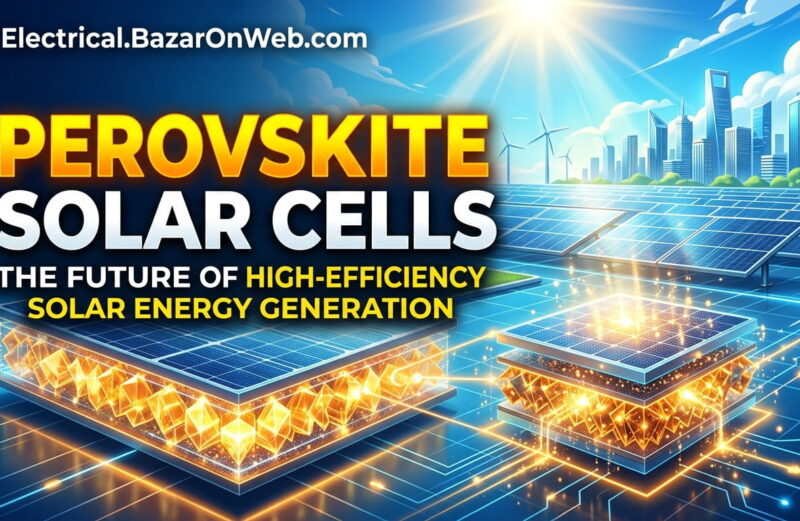
The structure of a perovskite solar cell typically consists of:
- Transparent conductive layer
- Electron transport layer
- Perovskite absorber layer
- Hole transport layer
- Metal electrode
Each layer performs a specific function to ensure efficient energy conversion. The perovskite absorber layer is the most important component because it determines how much sunlight can be captured and converted into electricity.
One major advantage of perovskite materials is their excellent light absorption capability. Even a very thin layer can absorb a significant amount of sunlight. This reduces material usage and manufacturing costs.
Additionally, these cells can perform efficiently under low-light and cloudy conditions, making them suitable for various climates. Researchers are continuously improving the stability and durability of these cells to make them commercially viable for long-term use.
The simplicity of their manufacturing process compared to silicon-based cells is another factor contributing to their growing popularity in the renewable energy sector.
Importance of Perovskite Solar Cells in Renewable Energy
Perovskite solar cells are considered highly important because they have the potential to transform renewable energy generation worldwide. As electricity demand continues to rise, countries are searching for sustainable and affordable energy alternatives. Solar energy is one of the cleanest solutions available, and perovskite technology can significantly improve its efficiency and affordability.
One of the biggest advantages is their low production cost. Traditional silicon solar panels require high-temperature manufacturing processes and expensive raw materials. Perovskite solar cells, however, can be produced using simpler methods and lower-cost materials, reducing overall manufacturing expenses.
Another important factor is their high efficiency. Higher efficiency means more electricity generation from the same amount of sunlight. This can reduce the area required for solar installations and increase energy output for residential and commercial systems.
Perovskite cells can also accelerate the global transition to renewable energy by making solar technology more accessible to developing countries. Affordable solar systems can help remote regions gain access to electricity without depending heavily on fossil fuels.
Their lightweight and flexible nature also creates new opportunities in building-integrated photovoltaics (BIPV). Solar windows, solar roofs, and portable solar devices can become more practical and efficient using perovskite technology.
From an environmental perspective, increased use of efficient solar systems can reduce carbon emissions and dependence on conventional power generation methods. This supports global efforts toward sustainability and climate change mitigation.
For the future of renewable energy, perovskite solar cells represent a major technological advancement with enormous potential.
Advantages of Perovskite Solar Cells
Perovskite solar cells offer several advantages that make them highly attractive for future solar energy systems. These benefits are the primary reasons researchers and industries are investing heavily in this technology.
One of the biggest advantages is their exceptional energy conversion efficiency. Perovskite solar cells can achieve high efficiency levels while using thinner material layers compared to silicon panels. This allows better sunlight utilization and improved performance.
Another significant benefit is low manufacturing cost. Traditional silicon panels require complex and energy-intensive manufacturing processes. Perovskite cells can be manufactured using solution-based methods, reducing production expenses and making solar energy more affordable.
Flexibility is another major advantage. These cells can be fabricated on lightweight and flexible materials, enabling applications in wearable electronics, curved surfaces, and portable solar chargers.
Perovskite solar cells also perform well under low-light conditions. This makes them suitable for regions with variable weather and less direct sunlight exposure.
Their lightweight structure simplifies transportation and installation. This can reduce labor costs and make solar deployment faster and easier.
Additionally, perovskite technology can be combined with silicon solar cells to create tandem solar cells. These hybrid systems can achieve even higher efficiencies than conventional panels alone.
Another benefit is faster manufacturing scalability. Since production processes are simpler, large-scale manufacturing facilities can potentially be developed at lower costs.
All these advantages position perovskite solar cells as one of the most promising innovations in the renewable energy industry.
Challenges Facing Perovskite Solar Technology
Despite their impressive advantages, perovskite solar cells still face several challenges before becoming widely adopted commercially. Researchers around the world are actively working to solve these issues.
The biggest concern is long-term stability. Perovskite materials can degrade when exposed to moisture, heat, oxygen, and ultraviolet radiation. This affects the lifespan and reliability of the solar panels.
Traditional silicon solar panels can last 25 years or more, while perovskite cells currently struggle to achieve similar durability under real-world environmental conditions. Improving their resistance to weather and environmental stress is essential for commercial success.
Another challenge involves the use of lead in many perovskite materials. Lead is toxic and raises environmental and health concerns. Scientists are exploring lead-free alternatives, but maintaining high efficiency without lead remains difficult.
Large-scale manufacturing consistency is another issue. Producing laboratory-quality cells on an industrial scale while maintaining uniform performance can be technically challenging.
There are also concerns regarding encapsulation and protective coatings. Effective sealing methods are needed to prevent moisture and oxygen from damaging the cells.
Commercialization barriers include regulatory approvals, testing standards, and market acceptance. Since the technology is relatively new, many companies and consumers are still cautious about long-term investments.
However, despite these challenges, research progress is extremely encouraging. Significant improvements are being made every year, and experts believe that many of these issues can eventually be resolved through advanced material engineering and manufacturing innovations.
The future remains highly promising for perovskite solar technology.
Comparison Between Perovskite and Silicon Solar Cells
Perovskite solar cells and traditional silicon solar cells differ in several important ways. Understanding these differences helps explain why perovskite technology is attracting so much attention.
Silicon solar panels currently dominate the global solar market because they are highly durable, reliable, and commercially proven. They offer long operational life and stable performance under different environmental conditions.
Perovskite solar cells, on the other hand, are relatively new but offer several performance advantages. One major difference is manufacturing complexity. Silicon panels require high-temperature processing and expensive purification methods, whereas perovskite cells can be manufactured using simpler and cheaper techniques.
Efficiency is another important comparison point. Modern silicon panels generally achieve efficiencies around 20–23%, while advanced perovskite cells have already crossed 25% efficiency in research environments.
Weight and flexibility also distinguish the two technologies. Silicon panels are rigid and relatively heavy, while perovskite cells can be lightweight and flexible.
However, silicon solar panels still outperform perovskite cells in durability and lifespan. Silicon technology has decades of proven reliability, whereas perovskite technology is still evolving.
Cost potential strongly favors perovskite technology in the future. If stability challenges are solved, these cells could dramatically reduce solar installation costs globally.
Another important development is tandem solar technology, where perovskite layers are combined with silicon cells to improve overall efficiency beyond the limits of standalone silicon panels.
Both technologies may eventually work together to create more efficient and affordable renewable energy systems.
Applications of Perovskite Solar Cells
Perovskite solar cells have a wide range of potential applications due to their flexibility, lightweight design, and high efficiency. Their unique properties allow integration into areas where traditional solar panels are difficult to use.
One important application is building-integrated photovoltaics (BIPV). Perovskite solar materials can be integrated into windows, walls, roofs, and glass facades, transforming buildings into electricity-generating structures.
Portable electronics represent another promising sector. Flexible perovskite cells can power smartphones, laptops, wearable devices, and portable chargers.
Automotive applications are also growing. Solar-powered electric vehicles can use lightweight perovskite panels to improve energy efficiency and extend driving range.
Agricultural systems can benefit from semi-transparent perovskite solar panels used in greenhouses. These panels allow controlled sunlight transmission while generating electricity simultaneously.
Perovskite cells are also suitable for remote and off-grid locations due to their low manufacturing costs and lightweight transport advantages.
Space technology is another area of interest. Lightweight solar panels are valuable for satellites and aerospace applications where weight reduction is critical.
Urban infrastructure may eventually include solar-powered bus stops, smart street lighting systems, and energy-generating public structures using perovskite technology.
Researchers are continuously exploring new applications because these cells can be customized in terms of transparency, color, and flexibility. This versatility gives perovskite solar technology enormous commercial potential in the coming years.
Future of Perovskite Solar Technology
The future of perovskite solar technology appears extremely promising as research and investment continue to grow rapidly worldwide. Governments, universities, and private companies are investing billions of dollars into improving efficiency, stability, and manufacturing scalability.
One major area of focus is tandem solar cells. Combining perovskite layers with silicon technology can achieve extremely high efficiencies beyond what conventional panels can provide alone. This hybrid approach may become the next generation of commercial solar panels.
Scientists are also developing more stable perovskite materials resistant to moisture, heat, and UV radiation. Improvements in encapsulation technologies are helping increase operational lifespan significantly.
Manufacturing advancements may soon enable roll-to-roll printing methods for solar cells, similar to newspaper printing processes. This could drastically reduce production costs and increase manufacturing speed.
The technology may also support decentralized energy generation. Lightweight and portable solar systems can bring electricity to remote areas lacking traditional grid infrastructure.
Countries aiming for carbon neutrality and sustainable energy goals are likely to adopt advanced solar technologies more aggressively in the future. Perovskite solar cells could play a major role in achieving these environmental objectives.
Commercialization is already progressing, with several companies beginning pilot production and field testing projects. Industry experts believe that widespread commercial adoption may occur within the next decade if stability challenges continue to improve.
Overall, the future of perovskite solar cells represents an exciting shift toward smarter, more affordable, and highly efficient renewable energy systems.
Role of Perovskite Solar Cells in Sustainable Development
Perovskite solar cells can significantly contribute to sustainable development by supporting clean energy generation, reducing environmental impact, and improving global energy accessibility.
One of the most important aspects of sustainability is reducing greenhouse gas emissions. Fossil fuel-based electricity generation contributes heavily to air pollution and climate change. Solar energy provides a clean alternative, and highly efficient perovskite cells can accelerate renewable energy adoption worldwide.
Affordable solar technology can also improve energy access in developing regions. Many rural communities still lack reliable electricity infrastructure. Low-cost perovskite systems can help deliver decentralized renewable power to these areas.
Energy-efficient buildings are another important sustainability goal. Building-integrated solar systems using perovskite materials can reduce dependence on external power sources and lower overall energy consumption.
The lightweight design of these solar cells reduces transportation energy and installation complexity, further supporting environmentally friendly deployment.
In industrial sectors, efficient renewable energy systems can help companies reduce operational costs while meeting sustainability regulations and carbon reduction targets.
Perovskite solar technology may also encourage innovation in smart cities, electric transportation, and portable renewable power solutions.
As global populations and electricity demands continue increasing, sustainable energy technologies will become essential for long-term environmental and economic stability. Perovskite solar cells have the potential to become a critical component of future sustainable infrastructure.
Their continued development can help create cleaner, more energy-efficient societies while reducing dependence on conventional fossil fuel resources.
Conclusion
Perovskite solar cells represent one of the most exciting advancements in modern renewable energy technology. Their high efficiency, lower manufacturing costs, flexibility, and wide application potential make them a strong candidate for the future of solar power generation.
Although challenges such as long-term stability and environmental concerns still exist, rapid technological progress is bringing this innovation closer to large-scale commercial adoption. Researchers and energy companies worldwide are continuously improving performance, durability, and manufacturing processes.
As someone with over 25 years of experience in electrical engineering and solar energy systems, I strongly believe that perovskite technology will play a major role in shaping the future of clean energy. These advanced solar cells have the potential to make renewable energy more affordable, efficient, and accessible for homes, industries, and developing regions globally.
The transition toward sustainable energy is no longer optional—it is essential. Innovations like perovskite solar cells can help meet rising electricity demands while reducing environmental impact and promoting energy independence.
The coming decade may witness significant breakthroughs in this technology, making solar energy generation smarter, cheaper, and more efficient than ever before.